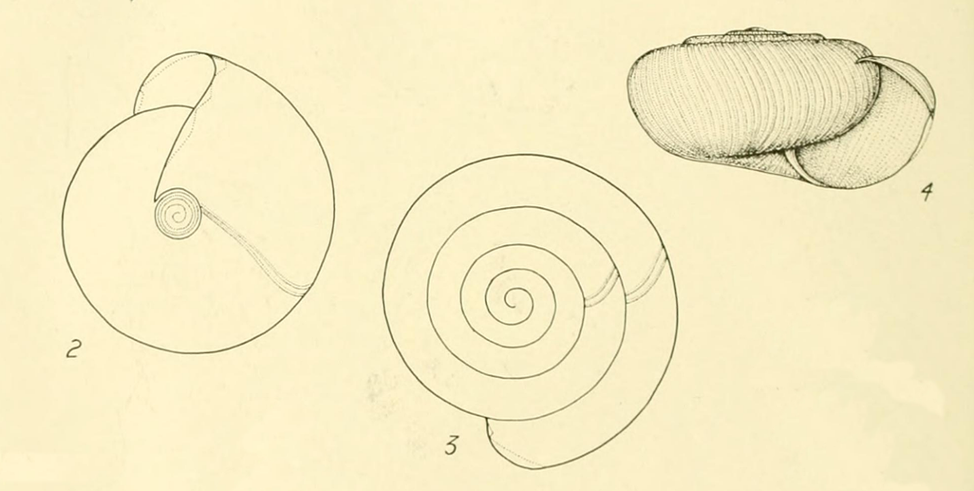
- Radiodiscus (Radiodomus) abietum H.B. Baker 1930a: 124, pl. 6 figs 1–7
Identification. Shell small, nearly opaque, pale brown (“light chocolate brown”; Baker 1930), subdiscoidal, umbilicate, thin. Spire nearly flat, rather tightly coiled. Whorls as many as 5¾, convex, but markedly flattened above, shouldered. Last whorl shouldered; periphery above middle of whorl. Last whorl slightly deflected downwards. Suture deep. Base well rounded. Protoconch 2–2¼ whorls, with prominent, close, spiral threads (Miquel & Cádiz Lorca 2008: fig. 15). Teleoconch with numerous, low, sharp, strongly curved colabral riblets (“protracted near umbilicus; scarcely arcuate near suture”; interspaces 2–3× broader than riblets) and finer, very closely spaced spiral striae. Periostracum heavy, almost opaque. Aperture narrowly lunate (deeply concave below periphery), edentulous, slightly oblique. Lip thin, simple. Parietal callus weak. Umbilicus small, steep-walled, c. 1/6 of shell width. Width to 6.7 mm (shell wider than high).
The sides of the foot are slightly pigmented, and the head and tentacles are black according to Baker (1930), who also described various organs, including the genitalia (Baker 1930: pl. 6, figs 5, 7).
Comparison. This species differs from Discus species in having spiral lirae, teleoconch sculpture of much finer colabral riblets, and a much more narrowly crescent-shaped aperture.
Habitat. In mixed-wood forests, mostly in moist sites or near streams (Baker 1930; Hendricks 2012). Medium- and high-elevation forests (Frest and Johannes 2001).
Geographic range. In BC, this species only recently has been found in the southeast (Ovaska et al. 2020). Northern Idaho (Frest and Johannes 2001), Montana west of the Continental Divide (Brunson & Russell 1967).
Etymology. Radiodomus: from radio (Latin), to radiate + domus, house or home; the gender is feminine. Abietum: of the firs, i.e., the true firs, genus Abies Mill.
Remarks. This species was originally described as a species of Radiodiscus Pilsbry & Ferris, 1906, subgenus Radiodomus in the family Endodontidae (Baker 1930a). Pilsbry (1948) treated placed itin the family Punctidae, and later it was considered to belong to Charopidae. Recently, based on molecular phylogenetics, Radiodomus was removed from Charopidae and classified as belonging to Discidae (Salvador et al. 2020, 2023).
References
- Baker HB (1930) New and problematic West American land-snails. The Nautilus 43: 95–101, pls 5, 6. https://www.biodiversitylibrary.org/page/8515145
- Brunson RB, Russell RH (1967) Radiodiscus, new to molluscan fauna of Montana. The Nautilus 81: 18–22. https://www.biodiversitylibrary.org/page/8528008
- Frest TJ, Johannes EJ (2000 [2001]) An annotated checklist of Idaho land and freshwater mollusks. Journal of the Idaho Academy of Science 36: 1–51.
- Hendricks P (2012) A guide to the land snails and slugs of Montana. A report to the U.S. Forest Service – Region 1. Montana Natural Heritage Program, Helena, Montana, vii + 187 pp., appendices.
- Miquel SE, Cádiz Lorca FJ (2008) Araucocharopa gallardoi gen. et sp. n. de Charopidae (Mollusca: Gastropoda: Stylommatophora) del sur de Chile. Revista del Museo Argentino de Ciencias Naturales (n.s.) 10: 329–340. https://doi.org/10.22179/revmacn.10.287
- Ovaska K, Sopuck L, Heron J (“2019” 2020) Surveys for terrestrial gastropods in the Kootenay region of British Columbia, with new records and range extensions. The Canadian Field-Naturalist 133: 221–234. https://doi.org/10.22621/cfn.v133i3.2287
- Salvador RB, Brook FJ, Shepherd LD, Kennedy M (2020) Molecular phylogenetic analysis of Punctoidea (Gastropoda, Stylommatophora). Zoosystematics and Evolution 96: 397–410. https://doi.org/10.3897/zse.96.53660
- Salvador RB, Ravalo LGO, de Winter AJ (2023) Phylogenetic position of Canaridiscus and reestablishment of Gonyodiscus (Gastropoda, Discidae). Archiv für Molluskenkunde 152: 159–166. https://doi.org/10.1127/arch.moll/152/159-166