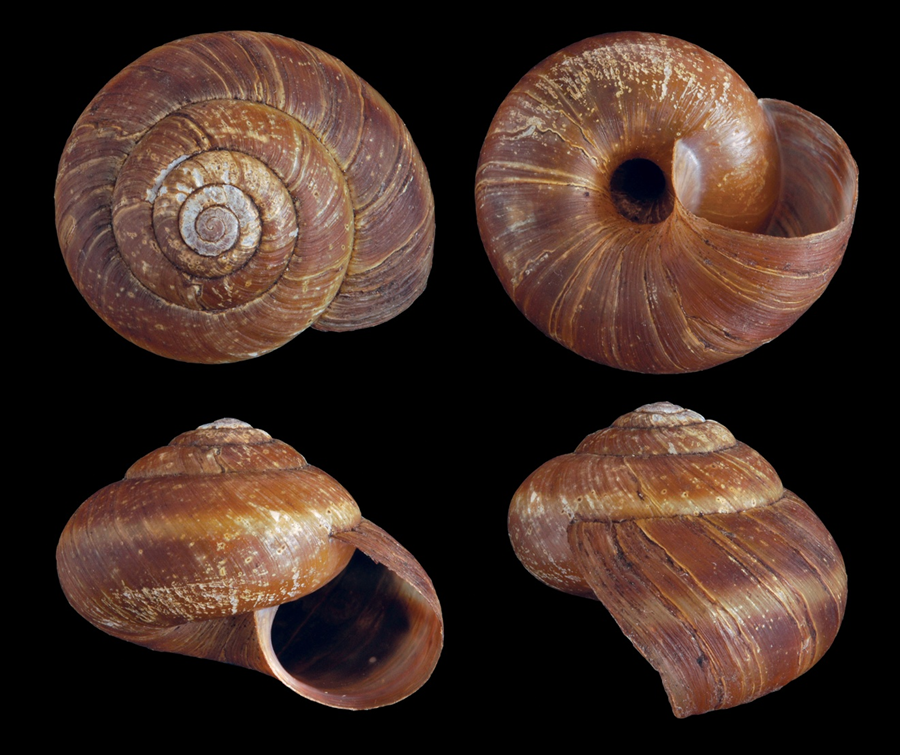
Tag: Discidae

  • Radiodomus abietum (H.B. Baker, 1930)

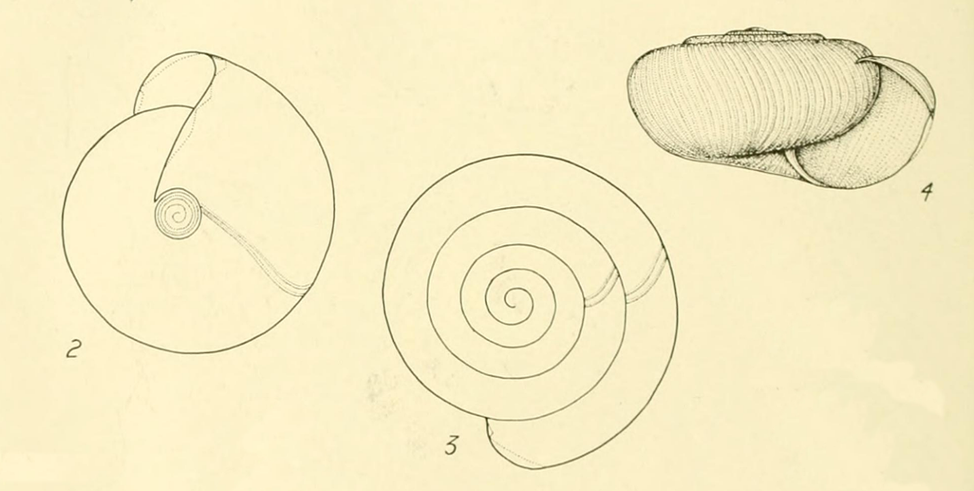
    Radiodomus abietum. After Baker (1930).
    • Radiodiscus (Radiodomus) abietum H.B. Baker 1930a: 124, pl. 6 figs 1–7

    Identification. Shell small, nearly opaque, pale brown (“light chocolate brown”; Baker 1930), subdiscoidal, umbilicate, thin. Spire nearly flat, rather tightly coiled. Whorls as many as 5¾, convex, but markedly flattened above, shouldered. Last whorl shouldered; periphery above middle of whorl. Last whorl slightly deflected downwards. Suture deep. Base well rounded. Protoconch 2–2¼ whorls, with prominent, close, spiral threads (Miquel & Cádiz Lorca 2008: fig. 15). Teleoconch with numerous, low, sharp, strongly curved colabral riblets (“protracted near umbilicus; scarcely arcuate near suture”; interspaces 2–3× broader than riblets) and finer, very closely spaced spiral striae. Periostracum heavy, almost opaque. Aperture narrowly lunate (deeply concave below periphery), edentulous, slightly oblique. Lip thin, simple. Parietal callus weak. Umbilicus small, steep-walled, c. 1/6 of shell width. Width to 6.7 mm (shell wider than high).

    The sides of the foot are slightly pigmented, and the head and tentacles are black according to Baker (1930), who also described various organs, including the genitalia (Baker 1930: pl. 6, figs 5, 7).

    Comparison. This species differs from Discus species in having spiral lirae, teleoconch sculpture of much finer colabral riblets, and a much more narrowly crescent-shaped aperture.

    Habitat. In mixed-wood forests, mostly in moist sites or near streams (Baker 1930; Hendricks 2012). Medium- and high-elevation forests (Frest and Johannes 2001).

    Geographic range. In BC, this species only recently has been found in the southeast (Ovaska et al. 2020). Northern Idaho (Frest and Johannes 2001), Montana west of the Continental Divide (Brunson & Russell 1967).

    Etymology. Radiodomus: from radio (Latin), to radiate + domus, house or home; the gender is feminine. Abietum: of the firs, i.e., the true firs, genus Abies Mill.

    Remarks. This species was originally described as a species of Radiodiscus Pilsbry & Ferris, 1906, subgenus Radiodomus in the family Endodontidae (Baker 1930a). Pilsbry (1948) treated placed itin the family Punctidae, and later it was considered to belong to Charopidae. Recently, based on molecular phylogenetics, Radiodomus was removed from Charopidae and classified as belonging to Discidae (Salvador et al. 2020, 2023).

    References

    • Baker HB (1930) New and problematic West American land-snails. The Nautilus 43: 95–101, pls 5, 6. https://www.biodiversitylibrary.org/page/8515145
    • Brunson RB, Russell RH (1967) Radiodiscus, new to molluscan fauna of Montana. The Nautilus 81: 18–22. https://www.biodiversitylibrary.org/page/8528008
    • Frest TJ, Johannes EJ (2000 [2001]) An annotated checklist of Idaho land and freshwater mollusks. Journal of the Idaho Academy of Science 36: 1–51.
    • Hendricks P (2012) A guide to the land snails and slugs of Montana. A report to the U.S. Forest Service – Region 1. Montana Natural Heritage Program, Helena, Montana, vii + 187 pp., appendices.
    • Miquel SE, Cádiz Lorca FJ (2008) Araucocharopa gallardoi gen. et sp. n. de Charopidae (Mollusca: Gastropoda: Stylommatophora) del sur de Chile. Revista del Museo Argentino de Ciencias Naturales (n.s.) 10: 329–340. https://doi.org/10.22179/revmacn.10.287
    • Ovaska K, Sopuck L, Heron J (“2019” 2020) Surveys for terrestrial gastropods in the Kootenay region of British Columbia, with new records and range extensions. The Canadian Field-Naturalist 133: 221–234. https://doi.org/10.22621/cfn.v133i3.2287
    • Salvador RB, Brook FJ, Shepherd LD, Kennedy M (2020) Molecular phylogenetic analysis of Punctoidea (Gastropoda, Stylommatophora). Zoosystematics and Evolution 96: 397–410. https://doi.org/10.3897/zse.96.53660
    • Salvador RB, Ravalo LGO, de Winter AJ (2023) Phylogenetic position of Canaridiscus and reestablishment of Gonyodiscus (Gastropoda, Discidae). Archiv für Molluskenkunde 152: 159–166. https://doi.org/10.1127/arch.moll/152/159-166
  • Discus whitneyi (Newcomb, 1864)

    Discus whitneyi, Tenas Creek, southwest of Telkwa, BC.
    • Helix striatella Anthony 1840: 278, pl. 3, fig. 2, non Helix striatella Rang, 1831.
    • Helix whitneyi Newcomb 1864: 118.
    • Helix cronkhitei Newcomb 1865: 180.
    • Patula ruderata cronkhitei f. viridula Cockerell 1890: 102, non-binomial.
    • Pyramidula striatella catskillensis Pilsbry 1898 (1897–1898): 141, nomen nudum.
    • Pyramidula striatella var. catskillensis Pilsbry 1898: 86.
    • Pyramidula cronkhitei anthonyi Pilsbry in Pilsbry & Ferriss 1906: 153.

    Identification. Shell subdiscoidal. Spire low. Whorls 4½–5, with periphery of last whorl subangular to convex. Protoconch smoothish perhaps very minutely granular. Teleoconch with sharp, rather regular, colabral ribs that continue undiminished in size onto base. Aperture subovate. Lip not thickened or only very slightly, simple; columellar lip a bit expanded. Umbilicus c. ¼–⅓ of shell width. Shell brown, slightly reddish brown or darker, with a silken sheen.

    Animal pale grey. Head and tentacles darker grey or blackish; sides of foot with pale, with tiny brown speckles.

    Comparison. This species is distinguished from D. shimekii by its smaller, more reddish than yellowish shell, with a well-ribbed base, and an umbilicus with less steep sides.

    Habitat. Forests of all types, as well as some open habitats and drier parts of wetland habitats (marshes). Snails usually live under rocks, coarse woody debris, and logs and in leaf litter and vegetation.

    Geographic distribution. In BC, common in northern and interior regions but rare along most of the coast. Widespread across boreal and temperate North America and known from every province and territory of Canada.

    Etymology. Discus, from the Greek discos, a disc; the gender is masculine. This species was named after Josiah Dwight Whitney (1819–1896), an American geologist, professor of geology at Harvard University (from 1865), and chief of the California Geological Survey (1860–1874) (Wikipedia).

    Remarks. Discus whitneyi was for many years known as D. cronkhitei (Newcomb, 1865). However, Roth (1988) demonstrated that D. whitneyi is an earlier name for the species. By using Article 23.9 of the Code (ICZN 1999), Helix whitneyi could have been declared a nomen oblitum and Helix cronkhitei a nomen protectum, but this was not done, and D. whitneyi was rapidly adopted as the accepted name and is now general use.

    Some authors have suggested that the Palaearctic D. ruderatus is the same species (e.g. Dall 1905; Umiński 1962) and others have accepted this as fact (Kerney & Cameron 1979; Welter-Schultes 2012). However, these species were found to be separate in the molecular phylogenetic analysis by Salvador et al. (2020).

    References

    • Anthony JG (1840) Descriptions of three new species of shells. Boston Journal of Natural History 3: 278–279, pl. 3 figs 1–3.
    • Cockerell TDA (1890) A list of the Mollusca of Colorado. The Nautilus 3: 99–103.
    • Dall WH (1905) Land and fresh water mollusks. Doubleday, Page and Co., New York, New York, USA, 1–171, 2 pls.
    • ICZN (1999) International Code of Zoological Nomenclature, Fourth Edition. The International Trust for Zoological Nomenclature, London, UK, pp. https://code.iczn.org/
    • Kerney MP, Cameron RAD (1979) A field guide to the land snails of Britain and north-west Europe. Collins, London, United Kingdom, 288 pp, 24 pls.
    • Newcomb W (1864) Descriptions of nine new species of Helix inhabiting California. Proceedings of the California Academy of Sciences 3: 115–119.
    • Newcomb W (1865) Description of new species of land shells. Proceedings of the California Academy of Sciences 3: 179–182.
    • Pilsbry HA (1898) [Catalogue of American land shells with localities]. The Nautilus 11: 138–144.
    • Pilsbry HA (1898) Descriptions of new species and varieties of American Zonitidæ and Endodontidæ. The Nautilus 12: 85–87.
    • Pilsbry HA, Ferriss JH (1906) Mollusca of the southwestern states. II. Proceedings of The Academy of Natural Sciences of Philadelphia 58: 123–175.
    • Roth B (1988 “1987”) Identities of two Californian land mollusks described by Wesley Newcomb. Malacological Review 20: 129–130.
    • Salvador RB, Brook FJ, Shepherd LD, Kennedy M (2020) Molecular phylogenetic analysis of Punctoidea (Gastropoda, Stylommatophora). Zoosystematics and Evolution 96: 397–410. https://doi.org/10.3897/zse.96.53660
    • Umiński T (1962) Revision of the Palearctic forms of the genus Discus Fitzinger, 1833 (Gastropoda, Endodontidae). Annales Zoologici 20: 299–333.
    • Welter-Schultes F (2012) European Non-marine Molluscs, a Guide for Species Identification. Bestimmungsbuch für europäische Land- und Süsswassermollusken. Planet Poster Editions, Göttingen, [3] + 679 + [78] pp.
  • Gonyodiscus rotundatus (O.F. Müller, 1774)

    Gonyodiscus rotundatus, from Queen Elizabeth Park, Vancouver, BC.
    • Helix rotundatus O.F. Müller 1774: 29.
    • Other synonyms in the European literature.

    Identification. Shell subdiscoidal. Spire very low, slightly domed. Whorls c. 5½–6, rather closely coiled, rather slowly enlarging. Periphery shouldered, subangular, above middle of last whorl. Protoconch c. 1¼ whorls, smooth. Teleoconch with sharp, somewhat regular, slightly sinuous colabral riblets, weaker on base. Aperture transversely subovate, wider than high, edentulous. Lip not or scarcely thickened, simple, oblique and slightly sinuous from side. Umbilicus c. 1/3 of shell width, clearly showing all whorls within. Shell pale brown, grey-brown, or darker brown, with red-brown spots (actually colabral bands) in an alternating pattern (or rarely pale and without spots). Shell small, width to c. 4.5 mm (wider than high).

    The animal is blue-black or grey, but paler on lower sides of foot, which is rounded in front and pointed at the back. The ocular tentacles are dark and almost cylindrical.

    Comparison. Gonyodiscus rotundatus is readily recognized from all other land-snail species in BC by the alternating pattern of reddish-brown spots. However, care must be taken because shells rarely may be entirely unspotted and pale (Taylor 1914 in 1906–1914; iNaturalist). The whorls are more tightly coiled than either Discus species.

    Habitat. In BC, this species is known to occur in unkempt gardens, parks, waste ground, and other generally weedy, unkempt, disturbed places.

    Biology. Most reproduction takes place in July and August (Kuźnik-Kowalska 1999). Eggs are fully calcified, pearly-white, and 0.6–1.0 mm in diameter and 1–11 eggs are laid per clutch. German (1930) reported that eggs are laid in May through to September, hatching in 10­–12 days; Kuźnik-Kowalska (1999) indicated that incubation was slightly longer, 14–36 days. This species is known to carry some eggs inside the umbilical cavity of the shell (Kuźnik-Kowalska & Pokryszko 2007).  Following hatching, growth is apparently quick add a shell whorl each 33–35 days, until reaching maturity; snails reach maturity at 5½ whorls in their second or third year (or one year according to Germain 1930), and live for 2½–3½ years (Kuźnik-Kowalska 1999).

    Geographic range. Introduced to BC, where it is known from several places in Vancouver (Forsyth et al. 2016) and Burnaby (iNaturalist). Elsewhere in Canada, introduced to Ontario (Toronto), Quebec (Montreal), New Brunswick (Saint John), Nova Scotia (Halifax), and Newfoundland (several places on the Avalon Peninsula) (Örstan 2012; Forsyth et al. 2016). Overall, this species is still very much localized in BC and Canada, and not widespread, as are many non-native land molluscs. In the USA, introduced to several states, including Washington, California, Michigan, Ohio, Pennsylvania, New York, Vermont, and Maine (Forsyth et al. 2016).

    Southern Scandinavia and the British Isles, south through the Iberian Peninsula to Algeria (Welter-Schultes 2012); east to the Baltic countries, Belarus, Romania, Ukraine including Crimea (Sysoev and Schileyko 2009), south to Greece (Georgopoulou et al. 2025); Madeira (Seddon 2008), and the Azores (Backhuys 1975). Introduced elsewhere, including to Istanbul, Turkey (Örstan 2003) and South Africa (Herbert 2010).

    Etymology. Gonyodiscus: gonia (Greek), angle + discus (Latin), a disc; the gender is masculine. Rotundatus (Latin), rounded.

    Remarks. Until recently, this species was thought to belong to the genus Discus, but in their molecular analysis Salvador et al. (2023) found that it is not so closely related to Discus and proposed that Gonyodiscus be considered a full genus, not subgenus of Discus. Earlier, Umiński (1962) had noticed anatomical differences in the genitalia, with Discus having the penis retractor muscle attaching at the terminal end of the penis and the vas deferens with a lateral attachment on the penis; in Gonyodiscus, the penis retractor is attached laterally to the penis and the vas deferens attached terminally.

    Some European authors (e.g. Falkner et al. 2002; Gargominy et al. 2011) have recognized at least two subspecies—the nominal subspecies and the Iberian G. rotundatus omalisma (Fagot, 1879), which has an even more flattened shell with a broader umbilicus (e.g. Gargominy & Ripken 2011). Although subspecies are not used here, BC snails seem to belong to the widespread, nominate subspecies, G. rotundatus rotundatus.

    References

    • Forsyth RG, Maunder JE, McAlpine DF, Noseworthy RG (2016) Distributional status of an introduced land snail Discus rotundatus (Rotund Disc, Mollusca: Discidae) in Canada. The Canadian Field-Naturalist 130: 235–246. https://doi.org/10.22621/cfn.v130i3.1887
    • Gargominy O, Ripken TEJ (2011) Une collection de référence pour la malacofaune terrestre de France. MalaCo Hors Série 1: 1–108.
    • Germain L (1930) Mollusques terrestres et fluviatiles (première partie). Faune de France 21: 1-478.
    • Georgopoulou E, Oraiopoulos N, Psirofonia P, Kollaros D (2025) Current status and distribution of alien land snails and slugs in Greece. Journal of Conchology 45: 679-694. https://doi.org/10.61733/jconch/4560
    • Kuźnik-Kowalska E (1999) Life cycle and population dynamics of Discus rotundatus (O. F. Müller, 1774) (Gastropoda: Pulmonata: Endodontidae). Folia Malacologica 7: 5–17. https://doi.org/10.12657/folmal.007.001
    • Kuźnik-Kowalska E, Pokryszko BM (2007) Incipient parental care in Discus—a plesiomorphic state of a truly endodontid character? Journal of Conchology 39: 467–468.
    • Müller OF (1774) Vermium terrestrivm et fluviatilium, seu animalium infusorium, helminthicorum, et testaceorum, non marinorum, succincta historia. Volumen alterum: testacea. Heineck & Faber, Havniæ & Lipsiæ, xxxvi + 214 + [x] pp. https://doi.org/10.5962/bhl.title.46299
    • Örstan A (2012) The first record of the European land snail Discus rotundatus (Müller, 1774) from Montreal, Canada (Discidae: Pulmonata). Check List 8: 537–539.
    • Salvador RB, Ravalo LGO, de Winter AJ (2023) Phylogenetic position of Canaridiscus and reestablishment of Gonyodiscus (Gastropoda, Discidae). Archiv für Molluskenkunde 152: 159–166. https://doi.org/10.1127/arch.moll/152/159-166
    • Taylor JW (1906–1914) Monograph of the land & freshwater Mollusca of the British Isles. Zonitidæ. Endodontidæ. Helicidæ. Taylor Brothers, Leeds.
    • Umiński T (1962) Revision of the Palearctic forms of the genus Discus Fitzinger, 1833 (Gastropoda, Endodontidae). Annales Zoologici 20: 299–333.
  • Anguispira occidentalis (E. von Martens, 1882)

    Anguispira occidentalis, from Grohman Narrows, BC.
    • Patula solitaria var. occidentalis E. von Martens 1882: 140.
    • Anguispira kochi eyerdami Clench & Banks 1939: 285, pl. 36 fig. 3.

    Identification. Shell subglobose. Spire moderately elevated, conic, with slightly convex sides. Whorls c. 5½–6. Periphery medial, evenly convex. Last whorl slightly descending in oldest individuals. Teleoconch with coarse, low colabral riblets on early whorls, weaker on later whorls. Aperture rounded-lunate, slightly higher than wide, edentulous. Lip simple, thin but slightly thickened in some adults. Umbilicus c. 1/7 of shell width. Shell matte, usually dark brown, with darker, obscure spiral bands, one at periphery and one above on shoulder, which border a slightly paler band between. Shell to 25.5 mm wide (wider than high).

    Animal reddish brown, with darker, greyish tentacles.

    Comparison. Weathered shells of Oreohelix subrudis, with which A. occidentalis co-occurs may be confused.

    Habitat. In BC, this snail of typical of moist, mature mixed-wood forests, frequently in riparian areas along near bodies of water, that are well vegetated and with deep leaf litter and abundant coarse woody debris (COSEWIC 2017; Forsyth et al. 2025).

    Geographic distribution. In southwestern BC, Kootenay region, along Kootenay Lake and River and the south-eastern portion of the Columbia River. BC south to Oregon, Idaho, and western Montana (Pilsbry 1948; Forsyth et al. 2025).

    La Rocque’s (1953) doubtful of inclusion of this species in the fauna of Alberta seems highly unlikely, and the basis of this might have been misidentified Oreohelix subrudis shells. Records of A. occidentalis from Utah and Colorado (e.g. Schileyko 2002; COSEWIC 2017) were also misidentified and instead belong to Oreohelix (Forsyth et al. 2025).

    Etymology. Anguispira, derived from the Latin words anguis, a snake + spira, a spiral or coil; the gender is feminine. Occidentalis (Latin), western.

    Remarks. Pilsbry (1948) recognized the western A. occidentalis as a subspecies of Anguispira kochi, although he could find no clear morphological characters to distinguish them. Forsyth et al. (2025) used mitochondrial and nuclear gene sequences from throughout the distribution of A. kochi sensu lato to produce a phylogenetic analysis which found a sizeable genetic distance between eastern and western populations. Given the large geographical distance (2,000 km) between these populations, Forsyth et al. (2025) proposed that the taxa be treated as distinct species.

    Anguispira kochi eyerdami was described for small, darker, more depressed shells from Yakima Country, Washington State (Clench and Banks 1939), but Pilsbry (1948) noted a broad range of colour, relative heights, and sizes and occur throughout the range of A. occidentalis. Most British Columbia populations are this small, dark-shelled form. Most recently, Burke (2013) deemed eyerdami to be a separate subspecies, but his argument for this is unconvincing, and there are no molecular data available. Forsyth et al. (2025) treated A. k. eyerdami as a synonym of A. occidentalis, as it falls within the range of conchological and geographic range of A. occidentalis.

    This species has been assessed, as a designatable unit and subspecies of A. kochi, as Not at Risk by COSEWIC (2017).

    References

    • Burke TE (2013) Land snails and slugs of the Pacific Northwest. Oregon State University Press, Corvallis, Oregon, USA, 344 pp.
    • Clench WJ, Banks G (1939) A new subspecies of Anguispira kochi from Washington. Memorias de la Sociedad Cubana de Historia Natural 13: 285, pl. 3 fig. 3.
    • COSEWIC (2017) COSEWIC Assessment and Status Report on the Eastern Banded Tigersnail Anguispira kochi kochi and the Western Banded Tigersnail Anguispira kochi occidentalis, in Canada. Committee on the Status of Endangered Wildlife in Canada, Ottawa, Ottawa, Ontario, Canada, xv + 82 pp.
    • Forsyth RG, Nicolai A, Shoobs NF, Ali RF, Salvador RB (2025) A split decision: molecular and biogeographical evidence support species-level status of Anguispira kochi and Anguispira occidentalis (Stylommatophora, Discidae). ZooKeys 1261: 241–260. https://doi.org/10.3897/zookeys.1261.171098
    • La Rocque A (1953) Catalogue of the Recent Mollusca of Canada. National Museum of Canada, Bulletin 129: i–x, 1–406.
    • Martens E von (1882) [Einige Conchylien vor, welche Dr. Aurel und Arthur Krause während ihrer Rückreise von den Küsten des stillen Oceans durch Amerika gesammelt haben]. Sitzungsberichte der Gesellschaft Naturforschender Freunde zu Berlin 1882: 138–143.
    • Pilsbry HA (1948) Land Mollusca of North America (north of Mexico), vol. II, part 2. The Academy of Natural Sciences of Philadelphia, Monographs 3: i–xlvii + 521–1113.
    • Schileyko AA (2002) Treatise on Recent terrestrial pulmonate molluscs. Part 8: Punctidae, Helicodiscidae, Discidae, Cystopeltidae, Euconulidae, Trochomorphidae. Ruthenica Supplement 2: 1035–1166.