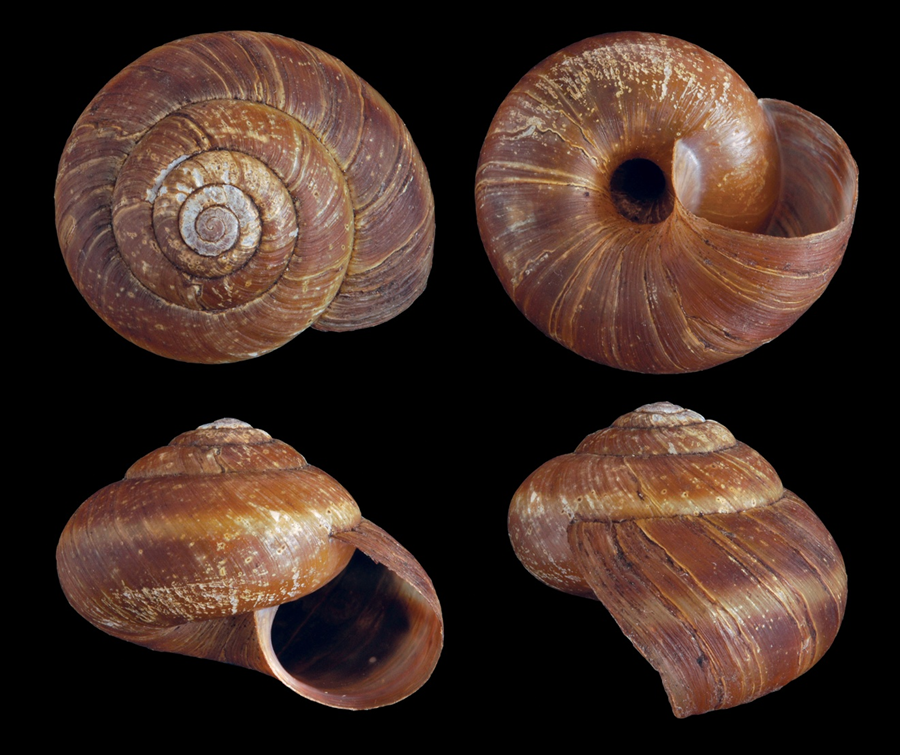
- Patula solitaria var. occidentalis E. von Martens 1882: 140.
- Anguispira kochi eyerdami Clench & Banks 1939: 285, pl. 36 fig. 3.
Identification. Shell subglobose. Spire moderately elevated, conic, with slightly convex sides. Whorls c. 5½–6. Periphery medial, evenly convex. Last whorl slightly descending in oldest individuals. Teleoconch with coarse, low colabral riblets on early whorls, weaker on later whorls. Aperture rounded-lunate, slightly higher than wide, edentulous. Lip simple, thin but slightly thickened in some adults. Umbilicus c. 1/7 of shell width. Shell matte, usually dark brown, with darker, obscure spiral bands, one at periphery and one above on shoulder, which border a slightly paler band between. Shell to 25.5 mm wide (wider than high).
Animal reddish brown, with darker, greyish tentacles.
Comparison. Weathered shells of Oreohelix subrudis, with which A. occidentalis co-occurs may be confused.
Habitat. In BC, this snail of typical of moist, mature mixed-wood forests, frequently in riparian areas along near bodies of water, that are well vegetated and with deep leaf litter and abundant coarse woody debris (COSEWIC 2017; Forsyth et al. 2025).
Geographic distribution. In southwestern BC, Kootenay region, along Kootenay Lake and River and the south-eastern portion of the Columbia River. BC south to Oregon, Idaho, and western Montana (Pilsbry 1948; Forsyth et al. 2025).
La Rocque’s (1953) doubtful of inclusion of this species in the fauna of Alberta seems highly unlikely, and the basis of this might have been misidentified Oreohelix subrudis shells. Records of A. occidentalis from Utah and Colorado (e.g. Schileyko 2002; COSEWIC 2017) were also misidentified and instead belong to Oreohelix (Forsyth et al. 2025).
Etymology. Anguispira, derived from the Latin words anguis, a snake + spira, a spiral or coil; the gender is feminine. Occidentalis (Latin), western.
Remarks. Pilsbry (1948) recognized the western A. occidentalis as a subspecies of Anguispira kochi, although he could find no clear morphological characters to distinguish them. Forsyth et al. (2025) used mitochondrial and nuclear gene sequences from throughout the distribution of A. kochi sensu lato to produce a phylogenetic analysis which found a sizeable genetic distance between eastern and western populations. Given the large geographical distance (2,000 km) between these populations, Forsyth et al. (2025) proposed that the taxa be treated as distinct species.
Anguispira kochi eyerdami was described for small, darker, more depressed shells from Yakima Country, Washington State (Clench and Banks 1939), but Pilsbry (1948) noted a broad range of colour, relative heights, and sizes and occur throughout the range of A. occidentalis. Most British Columbia populations are this small, dark-shelled form. Most recently, Burke (2013) deemed eyerdami to be a separate subspecies, but his argument for this is unconvincing, and there are no molecular data available. Forsyth et al. (2025) treated A. k. eyerdami as a synonym of A. occidentalis, as it falls within the range of conchological and geographic range of A. occidentalis.
This species has been assessed, as a designatable unit and subspecies of A. kochi, as Not at Risk by COSEWIC (2017).
References
- Burke TE (2013) Land snails and slugs of the Pacific Northwest. Oregon State University Press, Corvallis, Oregon, USA, 344 pp.
- Clench WJ, Banks G (1939) A new subspecies of Anguispira kochi from Washington. Memorias de la Sociedad Cubana de Historia Natural 13: 285, pl. 3 fig. 3.
- COSEWIC (2017) COSEWIC Assessment and Status Report on the Eastern Banded Tigersnail Anguispira kochi kochi and the Western Banded Tigersnail Anguispira kochi occidentalis, in Canada. Committee on the Status of Endangered Wildlife in Canada, Ottawa, Ottawa, Ontario, Canada, xv + 82 pp.
- Forsyth RG, Nicolai A, Shoobs NF, Ali RF, Salvador RB (2025) A split decision: molecular and biogeographical evidence support species-level status of Anguispira kochi and Anguispira occidentalis (Stylommatophora, Discidae). ZooKeys 1261: 241–260. https://doi.org/10.3897/zookeys.1261.171098
- La Rocque A (1953) Catalogue of the Recent Mollusca of Canada. National Museum of Canada, Bulletin 129: i–x, 1–406.
- Martens E von (1882) [Einige Conchylien vor, welche Dr. Aurel und Arthur Krause während ihrer Rückreise von den Küsten des stillen Oceans durch Amerika gesammelt haben]. Sitzungsberichte der Gesellschaft Naturforschender Freunde zu Berlin 1882: 138–143.
- Pilsbry HA (1948) Land Mollusca of North America (north of Mexico), vol. II, part 2. The Academy of Natural Sciences of Philadelphia, Monographs 3: i–xlvii + 521–1113.
- Schileyko AA (2002) Treatise on Recent terrestrial pulmonate molluscs. Part 8: Punctidae, Helicodiscidae, Discidae, Cystopeltidae, Euconulidae, Trochomorphidae. Ruthenica Supplement 2: 1035–1166.