Tag: Polygyridae

  • Cryptomastix mullani (Bland & J.G. Cooper, 1861)

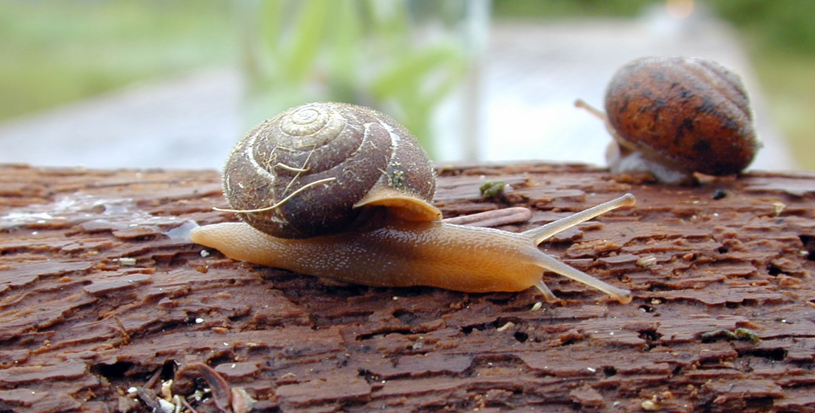
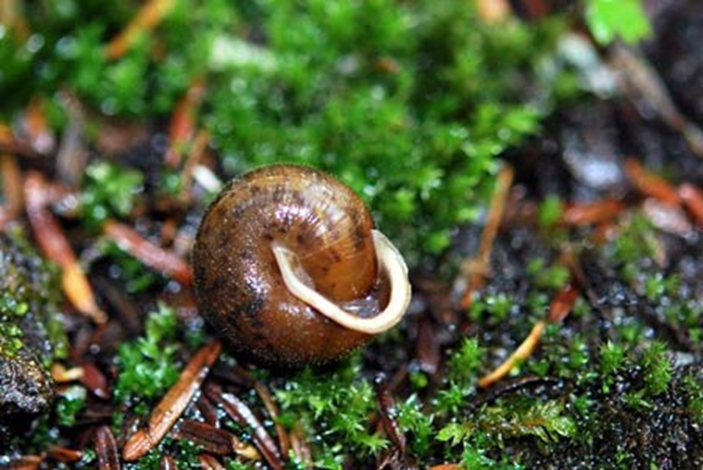
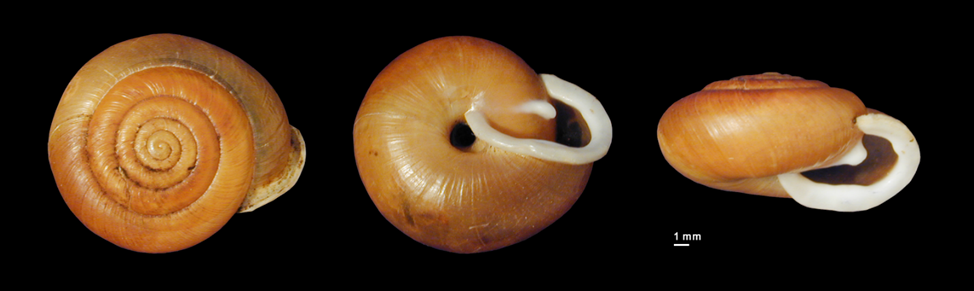
    Cryptomastix mullani, Kuskanook, E shore of Kootenay Lake, BC. Shell width 17.1 mm.
    • Helix mullani Bland & J.G. Cooper 1861: 363, 448, pl. 4 figs 16, 17.
    • Polygyra (Triodopsis) mullani var. olneyae Pilsbry 1891: 47.

    Identification. Shell depressed. Spire low-convex, low. Periphery rounded, medial. Whorls c. 5–6, convex. Suture well impressed. Protoconch with microscopic striae coarsely broken into granules. Teleoconch with incremental wrinkles/striae and weaker spiral striae, especially on base. Periostracum always without hairs (in adults). Aperture subovate-lunate, wider than high, dentulous in adults. Parietal denticle prominent, somewhat drop-shaped, elongate, and slightly curved in basal view, rather squarish in apertural view. Umbilicus c. 1/9of shell width, partly overhung by columellar lip. Lip distinctly thickened and strongly “rolled” back. Shell opaque, shining, greyish- to yellowish-brown; lip and parietal denticle white. Shell toc. 17.1 mm wide (wider than high).

    Animal dark greyish brown.

    Comparison. This species is quite unlike the only other Cryptomastix in BC; the shell of C. devia is more globose and less flattened.

    Habitat. Moist forests; under dead wood and vegetation and in scree.

    Geographic range. In BC, north to Revelstoke and west to Vernon (Pilsbry 1940) and Chase Creek near Chase (unpublished data). The historical Vernon record at first seems suspect, but with the discovery of this species along Chase Creek and in the vicinity, Vernon cannot be ruled out. However, whether habitat still exists in Vernon for this species remains to be determined.

    Etymology. Cryptos (Greek), “hidden” + mastix (Greek), “flagellum”, in reference to the genital anatomy (with a very short flagellum). Mullani: after Captain John Mullan Jr (1830–1909), US Army, who built the road over the Bitter Root and Rocky Mountains in 1853–1854 (Pilsbry 1940; Wikipedia).

    Remarks. The genus Cryptomastix, and certainly the group that containsC. mullani and similar species, appears in need of taxonomic revision. Following the classification of Pilsbry (1940), this species has several named subspecies. Few of these taxa are well known, and generally most have been largely ignored, relegated to obscurity due to their infraspecific rank. It is likely that at least some of these taxa are valid biological species, as already found in the genus Vespericola (e.g. Roth and Miller 1993, 1995, 2000), and all purported subspecies warrant further study. Burke (2013) provided descriptions and excellent photographs of most of these, but he did not offer any taxonomic innovation.

    Specimens from Vernon, BC were classified by Pilsbry (1940) as the subspecies olneyae, which had originally proposed by him as a variety (type locality: Spokane, Washington). For now, BC records are all referred to Cryptomastix mullani s.s. For now, British Columbia populations are all referred to C. mullani (sensu lato).
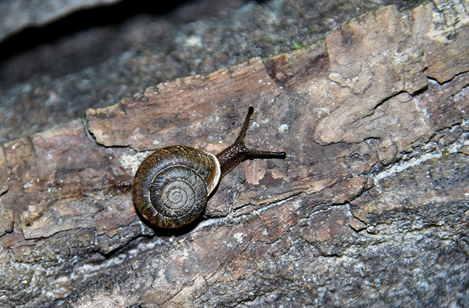
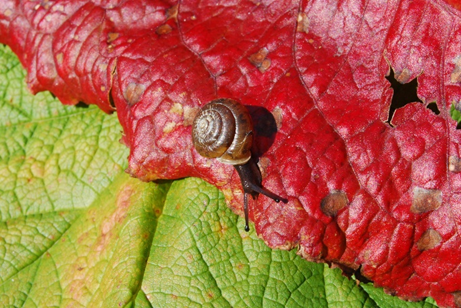
    Cryptomastix mullani, Chase Creek, BC.
    Cryptomastix mullani, Three Valley Gap, BC.

    References

    • Bland T, Cooper JG (1861) Notice of land and fresh-water shells, collected by Dr. J.G. Cooper in the Rocky Mountains, etc., in 1860. Annals of the Lyceum of Natural History of New York 7: 362–370. https://doi.org/10.1111/j.1749-6632.1862.tb00165.x
    • Burke TE (2013) Land snails and slugs of the Pacific Northwest. Oregon State University Press, Corvallis, Oregon, USA, 344 pp.
    • Pilsbry HA (1940) Land Mollusca of North America (north of Mexico), Volume I, Part 2. The Academy of Natural Sciences of Philadelphia, Monographs 3: i-viii + 1-994 + i-ix.
    • Pilsbry HA (1891) Polygyra (Triodopsis) mullani var. olneyae. The Nautilus 5: 47. https://www.biodiversitylibrary.org/page/42788790
    • Roth B, Miller WB (1993) Polygyrid land snails, Vespericola (Gastropoda: Pulmonata), 1. Species and populations formerly referred to Vespericola columbianus (Lea) in California. The Veliger 36: 134–144. https://www.biodiversitylibrary.org/page/42465744
    • Roth B, Miller WB (1995) Polygyrid land snails, Vespericola (Gastropoda: Pulmonata), 2. Taxonomic status of Vespericola megasoma (Pilsbry) and V. karokorum Talmadge. The Veliger 38: 133–144. https://www.biodiversitylibrary.org/page/42466795
    • Roth B, Miller WB (2000) Polygyrid land snails, Vespericola (Gastropoda: Pulmonata), 3. Three new species from northern California. The Veliger 43: 64–71. https://www.biodiversitylibrary.org/page/42460712
  • Allogona townsendiana (I. Lea, 1838)

    Allogona townsendiana, Hood Canal, Washington, USA; shell width: 25.7 mm.
    • Helix townsendiana I. Lea 1839: 99, pl. 23, fig. 80.
    • Polygyra townsendiana var. brunnea Vanatta (1924): 25.
    • Allogona (Dysmedoma) townsendiana form frustrationis Pilsbry (1940): 885, figs 509f , 510(1, 1a, 3).

    Identification. Shell depressed-heliciform. Spire conical. Whorls c. 6, rounded. Last whorl descending at aperture. Suture moderately impressed. Periphery rounded. Teleoconch with wide, not quite evenly spaces, low, axial riblets, coarser and less even than in A. ptychophora; spaces granular between striae (below suture and in the umbilical region), with closely spaced, spiral striae. Aperture subovate, edentulous, nearly as high as wide. Palatal and basal lips thickened, expanded, slightly recurved, contracted behind. Umbilicus open, overhung by columellar lip. Periostracum without hairs. Shell pale brown or yellowish brown, eroding greyish, with pale, straw-yellow streaks. Width to 26–33 mm (wider than high).

    Animal greyish brown; tentacles and spaces between tubercles darker.

    This species differs from A. ptychophora in having a larger shell, with coarser, more irregular axial riblets below the sutures and more pronounced malleation.

    Habitat. In moist forests. Often especially common in patches of stinging nettle.

    Geographic range. South-western British Columbia: Hope and west in the Fraser Valley to Burnaby and Port Coquitlam. On Vancouver Island, at Westholme, north of Duncan. BC south through coastal Washington to northwestern Oregon (Pilsbry 1940).

    Allogona townsendiana, Hopyard Hill, Agassiz, BC.

    Etymology. This species was named after John Kirk Townsend (1809–1851), ornithologist and naturalist from Philadelphia, who accompanied the 1834–1835 Wyeth Expedition across the Rockies to Fort Vancouver on the Columbia River west to Oregon and collected biological samples (Moring 2002).

    Remarks. Pilsbry (1940) recognized two forms (but not subspecies): brunnea Vanatta, 1924, and frustrationis Pilsbry, 1940. The brunnea form is characterized by having a darker shell, which occurs with normally pigmented shells in some populations throughout the range of the species, and it is almost certainly nothing other than a colour variant. Likely an ecophenotype, frustrationis was proposed for a form from Cape Disappointment, Washington, which was said to be relatively thinner and smoother shelled (Pilsbry 1940). Recently, Burke (2013) recognized this taxon as a putative subspecies, Allogona townsendiana frustrationis, although his reasons for this separation seem weak. No subspecies are used here.

    This species was first reported from BC by Whiteaves (1906) who mentioned a collection of “Polygyra ptychophora” from Mission Junction (present-day Mission), in the Fraser Valley. This record is most certainly within the range of A. townsendiana.

    COSEWIC (2002, 2013) assessed this species as Endangered in 2002 and again in 2013.

    References

    • Burke TE (2013) Land snails and slugs of the Pacific Northwest. Oregon State University Press, Corvallis, Oregon, USA, 344 pp.
    • COSEWIC (2002) COSEWIC assessment and status report on the Oregon Forestsnail Allogona townsendiana in Canada. Committee on the Status of Endangered Wildlife in Canada. Ottawa, Ottawa, ON, Canada, vi + 20 pp.
    • COSEWIC (2013) COSEWIC. 2013. COSEWIC assessment and status report on the Oregon Forestsnail Allogona townsendiana in Canada. Committee on the Status of Endangered Wildlife in Canada, Ottawa, ON, Canada, xii + 87 pp.
    • Lea I (1839 “1838”) Description of new freshwater and land shells. Transactions of the American Philosophical Society (New Series) 6: 1–154, pls 1–24. https://doi.org/10.2307/1005319
    • Moring J (2005) Early American naturalists: exploring the American West, 1804–1900. Taylor Trade Publications, Lanham, MD, USA, 260 pp.
    • Pilsbry HA (1940) Land Mollusca of North America (north of Mexico), Volume I, Part 2. The Academy of Natural Sciences of Philadelphia, Monographs 3: i–viii + 1–994 + i–ix.
    • Vanatta EG (1924) Descriptions of four new American shells. Proceedings of the Academy of Natural Sciences of Philadelphia 76: 25–27.
    • Whiteaves JF (1906) Notes on some land and fresh water shells from British Columbia. The Ottawa Naturalist 20: 115–119.
  • Vespericola columbianus (I. Lea, 1839)

    Vespericola columbianus, at Kitsault, BC.
    • Helix columbiana I. Lea 1839: 89, pl. 23, fig. 75.

    Identification.Shell subglobose-heliciform. Spire conical, low. Whorls 5–6, rather closely coiled, convex. Suture well-impressed. Periphery rounded, medial on last whorl. Protoconch with a few curved radial ripples then finely granular. Teleoconch with weak, irregular incremental wrinkles, fine wrinkling, and fine granulation. Periostracum with short, densely spaced, erect hairs (not always persisting in adults); when hairs worn off, scars evident in places. Last whorl descends a little to the adult lip. Aperture subovate-lunate, wider than high. No denticles in aperture. Lip expanded, not recurved, thin-edged, contracted behind. Umbilicus small, narrow, partially obscured by the lip. Shell rather thin, matte, usually dark brown or paler, honey-brown without animal; expanded lip whitish or pale brown-cream. Shell to 10–17 mm wide (wider than high).

    Animal tan to light grey-brown, usually with ocular tentacles darker. Dark blotches are visible through the shell wall in living animals.

    Comparison. The hairy periostracum, which is usually but not always retained in adults, is distinctive among land snails in BC, with only Micranepsia germana also having hairs on the periostracum. In V. columbianus, the hairs are slightly shorter and much more closely spaced than in M. germana; with this knowledge and some practice, even juveniles of these two species can be told apart.

    Habitat. In dry to wet forests, or sometimes in grassy, open seaside habitats; under logs and rocks, around Sword Ferns, and other shelter. Crawling in the open during wet weather.

    Geographic range. Along the entire BC coast, but there are occurrences extending inland up the valleys where moist Pacific air penetrates the mountains (Forsyth 2002). It is possibly rare in the wet interior mountains of south-eastern BC.

    Unalaska Island, Alaska, to Oregon (Roth & Miller 1993). Burke’s (2013) geographic ranges of Vespericola species seem confused (see Remarks).

    Etymology. Vespericola: derived from the Latin vesper, evening or west + colo, to inhabit; thus, “dwellers in the evening or west” (Pilsbry 1940: 892). The species was named after the Columbia River.

    Remarks. Isaac Lea (1839) described this species in a paper was read before the American Philosophical Society over several years. According to Tryon (1861), the part containing the description of Helix columbiana was read on 4 November 1838, but the pages of the Transactions in which it was printed did not appear until 1839. The correct date would appear to be 1839 unless there were separate pamphlets issued at the time of reading (It is not known that was the case), which would otherwise render the name available from 1838.

    In addition to the nominotypical subspecies, Pilsbry (1940) recognized four additional subspecies, but most of these are now believed to be full species (Roth & Miller 1993). Some authors have called hairy-shelled Vespericola from Alaska to Washington V. columbiana pilosa [sic] under the false impression that adult V. columbianus lack periostracal hairs. However, Roth & Miller (1993) found anatomical characters as well as subtle conchological characters to distinguish V. pilosus, a central Californian species, from northern Vespericola, and used V. columbianus for these northern populations. The only subspecies not removed and elevated to full species yet are V. columbianus depressus (Pilsbry & Henderson, 1936) and V. columbianus latilabrum Pilsbry, 1940. Vespericola columbianus depressus, from the Columbia Gorge (Oregon/Washington)was said by Frest & Johannes (1995) to be likely a separate species on account of conchological and anatomical differences (but with the details of the latter never published). The very much more expanded palatal lip of V. columbianus latilabrum is suggestive that is could also be a separate species.

    Burke’s (2013) accounts of Vespericola north of the Canada–USA border seem confused. He indicated that “V. columbianus spp.”, with periostracal hairs persistent in adults, occurs in BC and wrote that it is the taxon previously known (i.e. Pilsbry 1940) as “V. columbiana pilosa”. He seems to have ignored some of the findings of Roth & Miller (1993) who found the absence/presence of periostracal hairs to be not taxonomically significant, and that they identified specimens from Prince Rupert, Haida Gwaii, Port Hardy, and the Fraser Valley as V. columbianus. Moreover, Burke’s (2013) maps of “Vespericola columbianus columbiana” (with periostracal hairs usually lost in adults) and V. columbianus latilabrum show that these species also extend into BC, although this is contrary to his what he wrote in the text.

    The gender of the name Vespericola has been treated as either feminine or masculine by authors. Roth & Miller (1993) treated the name as masculine, in agreement with the first part of Article 30.1.4.2 of the Code (ICZN 1999). Although Pilsbry (1940) considered Vespericola to be feminine, he gave no indication of its gender when he proposed the name (Pilsbry 1939: xvii).

    Vespericola columbianus, at Glacier Gulch, Hudson Bay Mountain near Smithers, BC.

    References

    • Burke TE (2013) Land snails and slugs of the Pacific Northwest. Oregon State University Press, Corvallis, Oregon, USA, 344 pp.
    • Forsyth RG (2002 “2001”) New records of land snails from the mountains of northwestern British Columbia. The Canadian Field-Naturalist 115: 223–228. https://doi.org/10.5962/p.363781
    • Frest TJ, Johannes EJ (1995) Interior Columbia Basin mollusk species of special concern. Interior Columbia Basin Ecosystem Management Project, Walla Walla, Washington, USA, 274 pp.
    • ICZN (1999) International Code of Zoological Nomenclature, Fourth Edition. The International Trust for Zoological Nomenclature, London, UK, pp. https://code.iczn.org/
    • Lea I (1839 “1838”) Description of new freshwater and land shells. Transactions of the American Philosophical Society (new series) 6: 1–154, pls 1–24. https://doi.org/10.2307/1005319
    • Pilsbry HA (1940) Land Mollusca of North America (north of Mexico), Volume I, Part 2. The Academy of Natural Sciences of Philadelphia, Monographs 3: i–viii + 1–994 + i–ix.
    • Pilsbry HA (1946) Land Mollusca of North America (north of Mexico), vol. II, part 1. The Academy of Natural Sciences of Philadelphia, Monographs 3: frontispiece + i–vi + 1–520.
    • Roth B, Miller WB (1993) Polygyrid land snails, Vespericola (Gastropoda: Pulmonata), 1. Species and populations formerly referred to Vespericola columbianus (Lea) in California. The Veliger 36: 134–144.
    • Tryon GW, Jr (1861) List of American writers on Recent conchology with the titles of their memoirs and dates of publication. Baillière Brothers, New York, New York, USA, 68 pp.

  • Cryptomastix devia (A.A. Gould, 1846)

    Cryptomastix devia, from Auburn, Washington, USA.
    • Helix devia A.A. Gould 1846 (1846–1850): 165.
    • Helix baskervillei L. Pfeiffer 1850: 130.

    Identification. Shell depressed-globose. Spire conical, sides slightly convex. Periphery rounded, medial. Whorls c. 5–6, convex. Suture moderately indented. Protoconch c. 1½ whorls, initially smooth, then granular. Teleoconch with low, coarse, irregular striae, wrinkled below suture, and fine, shallow spiral lines. Aperture subovate-lunate, wider than high. Apertural denticle in adults: parietal tooth long, curved. Umbilicus small, c. 1/12 of W, almost entirely overhung by columellar lip. Shell opaque, semi-matte, yellowish brown; lip and parietal denticle whitish. Shell toc. 19–26 mm wide (wider than high).

    Comparison. This species is most like C. mullani but with a more raised spire.

    Habitat. Unknown for BC but moist, lowland forests below 600 ft [180 m] in the USA (Vagvolgyi 1968).

    Geographic range. Historically known in BC from Sumas Prairie in the Fraser Valley (Dall 1905) and Esquimalt on Vancouver Island (Taylor 1889), and more generally “Vancouver’s Island” (Pfeiffer 1850). Extreme south-western BC, south through western Washington to the Columbia Gorge, Oregon (Pilsbry 1940; Vagvolgyi 1968).

    Etymology. Cryptomastix: derived from the Greek kryptos, hidden + mastix, flagellum. Devius (Latin), solitary or out of the way.

    Remarks. This species was first reported from what was to become BC by Pfeiffer (1850), and it has not been seen alive in BC for many years and is presumed extirpated (COSEWIC 2002, 2013).

    References

    • COSEWIC (2002) COSEWIC assessment and status report on the Puget Oregonian snail Cryptomastix devia in Canada. Committee on the Status of Endangered Wildlife in Canada, Ottawa, Ontario, Canada, vi + 20 pp.
    • COSEWIC (2013) COSEWIC Status Appraisal Summary on the Puget Oregonian Cryptomastix devia in Canada. COSEWIC, Ottawa, Ontario, Canada, xv pp.
    • Dall WH (1905) Land and fresh water mollusks. Alaska Harriman Expedition. Volume 13. Doubleday, Page and Co., New York, New York, USA, 1–171, pls.
    • Pfeiffer L (1850) Descriptions of twenty-four new species of Helicea, from the collection of H. Cuming, Esq. Proceedings of the Zoological Society of London for 1849 17: 126–131.
    • Pilsbry HA (1940) Land Mollusca of North America (north of Mexico), Volume I, Part 2. The Academy of Natural Sciences of Philadelphia, Monographs 3: i–viii + 1–994 + i–ix.
    • Taylor GW (1889) The land shells of Vancouver Island. The Ottawa Naturalist 3: 84–94.
    • Vagvolgyi J (1968) Systematics and evolution of the genus Triodopsis (Mollusca: Pulmonata: Polygyridae). Harvard University, Museum of Comparative Zoology, Bulletin 136: 145–254.