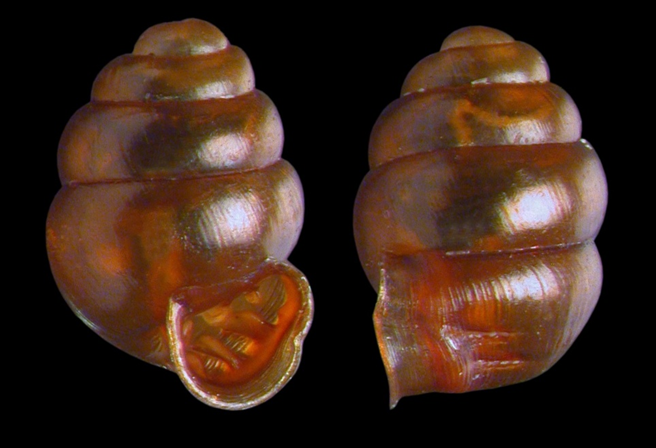
- P[upa] ovata Say 1822: 375. TL: Philadelphia, Pennsylvania, USA.
- Pupa (Vertigo) hydrophila Reinhardt 1877: 323, pl. 11 fig. 6. TL: Hakodate, Hokkaidō, Japan.
- Vertigo ovata mariposa Pilsbry 1919 (1918–1920): 88, pl. 6 figs 5, 6.
- Vertigo ovata diaboli Pilsbry 1919 (1918–1920): 88, pl. 6 figs 11, 12.
- Vertigo (Vertigo) eogea Pilsbry 1919 in 1918–1920: 151, pl. 14 figs 1–3. TL: Akkeshi, Kushiro on Hokkaidō, Japan.
- Plus other synonyms (see MolluscaBase)
Identification. Shell broadly subovate. Spire subconical, sides convex. Whorls c. 4, moderately convex. Suture deep. Protoconch smooth. Teleoconch nearly smooth, with fine, weak colabral striae only. Aperture auriform. Apertural dentition: usually 9 plicae and lamellae combined but sometimes fewer; plicae: 1 angular, 1 parietal, and 1 infraparietal; lamellae: 1 columellar, 1 subcolumellar, and 2 palatal, 1 supra- and 1 infrapalatal. Outer lip thin, strongly flared outward. Palatal callus present, strong. Auricle (sinulus) deeply, sharply indented. Crest low. Umbilicus present. Shell glassy, reddish brown. Shell to 2.5 mm high (higher than wide).
The animal is of a dark claret colour (i.e. burgundy) above, paler below (Gould 1843).
Comparison. Typically, V. ovata has many apertural denticles, which combined with the ovate shape, and shiny surface distinguish it from most other Vertigo species in BC. It is most like V. ventricosa, which differs in having fewer denticles and, most importantly, a more strongly conical (tapered) spire.
Habitat. This species occurs only in wetland habitats, such as along the shores of water bodies, in marshes, and in fens. It lives in leaf and grass litter, under woody debris, and on Bulrush (Typha L.) and other wetland vegetation.
Geographic range. Vertigo ovata is known from scattered localities across BC. However, this species is associated with wetland habitats, which are very much under-surveyed for terrestrial molluscs.
In North America, Alaska to Labrador, south to the Caribbean and Baja California (Pilsbry 1919; Nekola et al. 2018). Japan, Taiwan, and possibly mainland China (Nekola et al. 2018).
Etymology. Vertigo (Latin), a whorl. The gender is feminine. Ovata (Latin), egg-shaped.
Remarks. Pilsbry (1948) recognized two subspecies, V. ovata diaboli Pilsbry, 1919, described from Texas, and V. ovata mariposa Pilsbry, 1919, from California, but both taxa were synonymized with V. ovata by Roth & Sadeghian (2003). No subspecific taxa are currently recognized. However, in their molecular analysis of Vertigo, Nekola et al. (2018) found V. ovata to be polyphyletic, with three highly supported clades that contain a wide-ranging species (likely V. ovata of Say) and two additional undescribed species. These authors also found that two Asian taxa, V. hydrophila and V. eogea, are V. ovata.
In the literature, there is inconsistent usage of parentheses around the author and date of this species. Because Say (1822) presented this species as “P. ovata” where “P.” stood for Pupa, parentheses would be required when the species name is used in combination with the genus Vertigo. The complication to this is that Say included “P. ovata” under the heading “Genus Vertigo …” and “P.” seems to be an error for “V.”
References
- Gould AA (1843) Monograph of the species of Pupa found in the United Sates, with figures. Boston Journal of Natural History 4: 350–360, pl. 16.
- Pilsbry HA (1918–1920) Pupillidæ (Gastrocoptinæ, Vertiginæ). Manual of Conchology, Structural and Systematic with Illustrations of the Species Second Series: Pulmonata 25: 1–64, pls 1–5 [1918]; 65–244, pls 6–18 [1919]; 225–401, i–ix, pls 19–34 [1920].
- Pilsbry HA (1948) Land Mollusca of North America (north of Mexico), vol. II, part 2. The Academy of Natural Sciences of Philadelphia, Monographs 3: i–xlvii + 521–1113.
- Reinhardt O (1877) Diagnosen japanischer Landschnecken. Jahrbücher der Deutschen Malakozoologischen Gesellschaft 4: 320–325.
- Reinhardt O (1877) Über japanische Hyalinen, unter Zugrundelegung der Sammlungen des Herrn Hilgendorf. Sitzungs-Berichte der Gesellschaft Naturforschender Freunde zu Berlin 1877: 89–97. https://www.biodiversitylibrary.org/page/8796809
- Roth B, Sadeghian PS (2003) Checklist of the land snails and slugs of California. Santa Barbara Museum of Natural History Contributions in Science 3: 1–81.
- Say T (1822) Description of univalve terrestrial and fluviatile shells of the United States. Journal of the Academy of Natural Sciences of Philadelphia 2: 370–381. http://biodiversitylibrary.org/page/36831560
- Nekola JC, Chiba S, Coles BF, Drost CA, von Proschwitz T, Horsák M (2018) A phylogenetic overview of the genus Vertigo O. F. Müller, 1773 (Gastropoda: Pulmonata: Pupillidae: Vertigininae). Malacologia 61: 21–161. https://doi.org/10.4002/040.062.0104