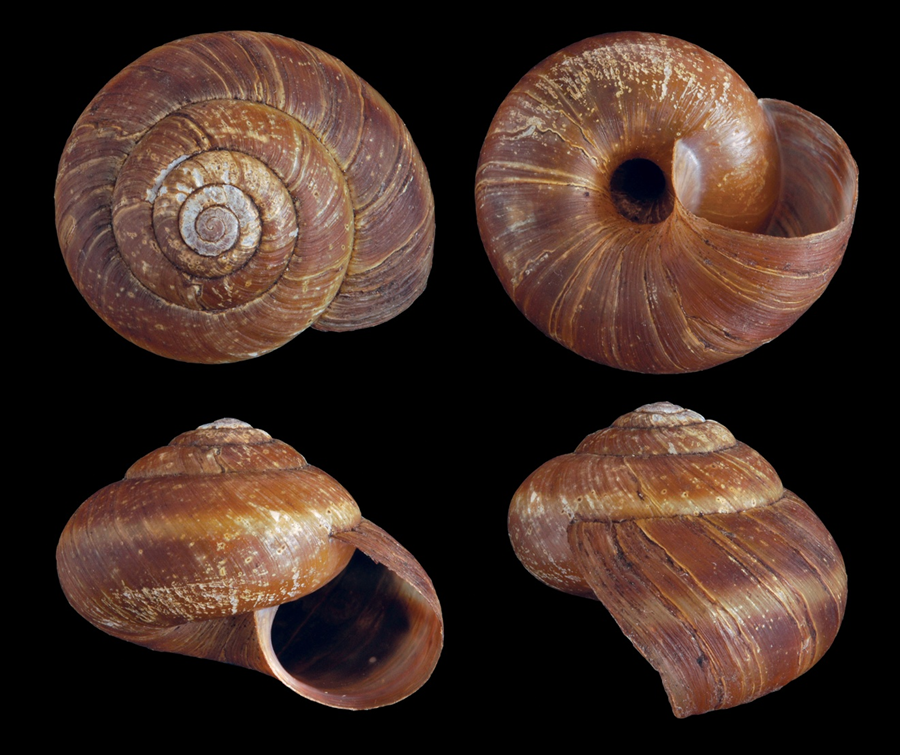
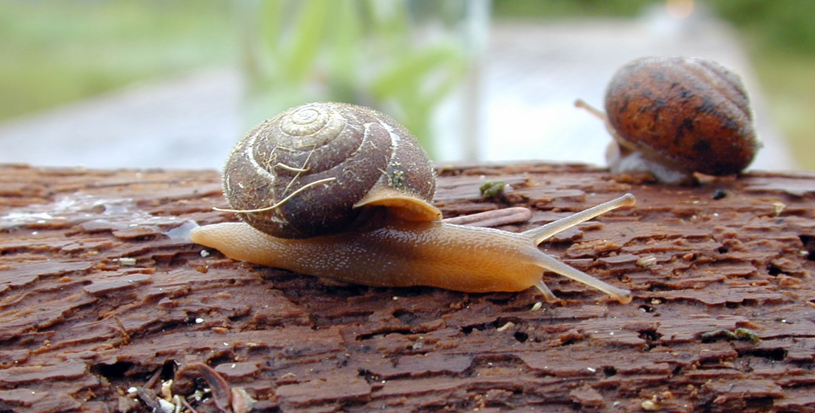
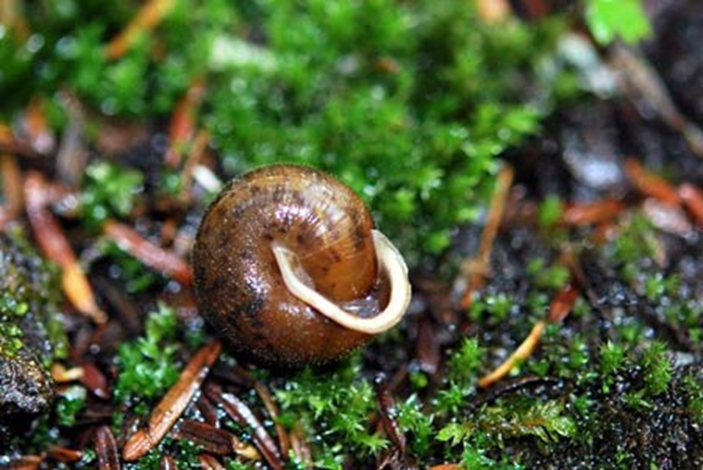
Category: Uncategorized

  • Vallonia pulchella (O.F. Müller, 1774)

    Vallonia pulchella from Smithers, BC; W 2.5 mm
    • Helix pulchella O.F. Müller 1774 in 1773–1774: 30.
    • Vallonia excentrica Sterki in Pilsbry 1893 in 1892–1893: 249, pl. 32 figs 6–9.

    Identification. Shell depressed. Spire low but elevated. Whorls c. 3–3½, convex. Periphery medial. Suture deep. Last whorl not or scarcely descending at adult aperture. Protoconch smooth. Teleoconch without lamellar riblets but with incremental striae and wrinkles. Aperture rounded, width and height about equal, edentulous. Lip abruptly expanded, heavily thickened within. Umbilicus c. ⅓ of shell width. Shell silken; thin, translucent, whitish or almost clear; thickened lip brilliant white and opaque. Shell to 2.5 mm (wider than high).

    Animal white, with black eye spots.

    Comparisons. This species differs from all other Vallonia species in BC in lacking well-formed colabral ribs. In strongly ribbed species, when these ribs are worn off, care must be taken not to mistake them for V. pulchella.

    Habitat. In BC, this species lives in gardens, in lawns, and on waste ground, under rocks, wood, debris, and vegetation. Snails are often associated concrete structures such as culverts and sidewalks, or under rocks, wood, and debris. Vallonia excentrica appears to occur only in anthropogenic habitats in BC, which is the basis for thinking that it is introduced.

    Geographic range. In BC, generally widespread. Grass (1967a) reported V. pulchella from BC for the first time, and Forsyth (2004b) thought it (along with the synonymous V. excentrica) to be introduced. It occurs across southern Canada east to Newfoundland. It is also present in Europe and introduced to many places worldwide.

    Etymology. Vallonia: named after either for the Roman goddess of valleys, Vallonia (Pilsbry 1948), or perhaps after the town of Vallon, Ardèche, south-central France (Kennard & Woodward 1926); the gender is feminine. Pulchella: diminutive of pulcher (Latin), lovely.

    Remarks. Vallonia excentrica was, until recently, considered to be a separate species. Nekola et al. (2025) analyzed mtDNA and nDNA sequences and found that many of the morphological characters used to differentiate purported species of Vallonia are rather remarkably variable. Included among these characters is the development of the final portion of the last whorl. In the past V. excentrica was differentiated from V. pulchella by its more gradual expansion (vs sudden expansion at nearly a right angle in V. pulchella—e.g. Pilsbry 1948; Gerber 1996; Forsyth 2004).

    Vallonia pulchella from Smithers, BC; width 2.4 mm. A specimen having the form of V. excentrica.

    References

    • Forsyth RG (2004) Land Snails of British Columbia. Royal BC Museum, Victoria, BC, Canada, iv, 188 pp.
    • Grass AL (1967) On Vallonia pulchella. Pacific Northwest Shell News 7: 43–44.
    • Kennard AS, Woodward BB (1926) Synonymy of the British non-marine Mollusca (Recent and post-Tertiary). British Museum (Natural History), London, United Kingdom, xxiv + 447 pp. https://doi.org/10.5962/bhl.title.8325
    • Müller OF (1774) Vermium terrestrivm et fluviatilium, seu animalium infusorium, helminthicorum, et testaceorum, non marinorum, succincta historia. Volumen alterum: testacea. Heineck & Faber, Havniæ & Lipsiæ, xxxvi + 214 + [x] pp. https://doi.org/10.5962/bhl.title.46299
    • Nekola JC, Gerber J, Horsáková V, Líznarová E, Kafimola S, Mikulášková E, Nováková M, Horsák M (2025) Taxonomic deception via obvious traits: oversplitting in European Vallonia Risso, 1826 (Mollusca: Gastropoda: Valloniidae). Zoologica Scripta 55: 37–51.  https://doi.org/10.1111/zsc.70024
    • Pilsbry HA (1892–1893) Helicidæ, Vol. VI. Manual of Conchology, Structural and Systematic with Illustrations of the Species Second Series: Pulmonata 8: 1–314, pls 1–58. https://www.biodiversitylibrary.org/page/1287448

  • Allogona townsendiana (I. Lea, 1838)

    Allogona townsendiana, Hood Canal, Washington, USA; shell width: 25.7 mm.
    • Helix townsendiana I. Lea 1839: 99, pl. 23, fig. 80.
    • Polygyra townsendiana var. brunnea Vanatta (1924): 25.
    • Allogona (Dysmedoma) townsendiana form frustrationis Pilsbry (1940): 885, figs 509f , 510(1, 1a, 3).

    Identification. Shell depressed-heliciform. Spire conical. Whorls c. 6, rounded. Last whorl descending at aperture. Suture moderately impressed. Periphery rounded. Teleoconch with wide, not quite evenly spaces, low, axial riblets, coarser and less even than in A. ptychophora; spaces granular between striae (below suture and in the umbilical region), with closely spaced, spiral striae. Aperture subovate, edentulous, nearly as high as wide. Palatal and basal lips thickened, expanded, slightly recurved, contracted behind. Umbilicus open, overhung by columellar lip. Periostracum without hairs. Shell pale brown or yellowish brown, eroding greyish, with pale, straw-yellow streaks. Width to 26–33 mm (wider than high).

    Animal greyish brown; tentacles and spaces between tubercles darker.

    This species differs from A. ptychophora in having a larger shell, with coarser, more irregular axial riblets below the sutures and more pronounced malleation.

    Habitat. In moist forests. Often especially common in patches of stinging nettle.

    Geographic range. South-western British Columbia: Hope and west in the Fraser Valley to Burnaby and Port Coquitlam. On Vancouver Island, at Westholme, north of Duncan. BC south through coastal Washington to northwestern Oregon (Pilsbry 1940).

    Allogona townsendiana, Hopyard Hill, Agassiz, BC.

    Etymology. This species was named after John Kirk Townsend (1809–1851), ornithologist and naturalist from Philadelphia, who accompanied the 1834–1835 Wyeth Expedition across the Rockies to Fort Vancouver on the Columbia River west to Oregon and collected biological samples (Moring 2002).

    Remarks. Pilsbry (1940) recognized two forms (but not subspecies): brunnea Vanatta, 1924, and frustrationis Pilsbry, 1940. The brunnea form is characterized by having a darker shell, which occurs with normally pigmented shells in some populations throughout the range of the species, and it is almost certainly nothing other than a colour variant. Likely an ecophenotype, frustrationis was proposed for a form from Cape Disappointment, Washington, which was said to be relatively thinner and smoother shelled (Pilsbry 1940). Recently, Burke (2013) recognized this taxon as a putative subspecies, Allogona townsendiana frustrationis, although his reasons for this separation seem weak. No subspecies are used here.

    This species was first reported from BC by Whiteaves (1906) who mentioned a collection of “Polygyra ptychophora” from Mission Junction (present-day Mission), in the Fraser Valley. This record is most certainly within the range of A. townsendiana.

    COSEWIC (2002, 2013) assessed this species as Endangered in 2002 and again in 2013.

    References

    • Burke TE (2013) Land snails and slugs of the Pacific Northwest. Oregon State University Press, Corvallis, Oregon, USA, 344 pp.
    • COSEWIC (2002) COSEWIC assessment and status report on the Oregon Forestsnail Allogona townsendiana in Canada. Committee on the Status of Endangered Wildlife in Canada. Ottawa, Ottawa, ON, Canada, vi + 20 pp.
    • COSEWIC (2013) COSEWIC. 2013. COSEWIC assessment and status report on the Oregon Forestsnail Allogona townsendiana in Canada. Committee on the Status of Endangered Wildlife in Canada, Ottawa, ON, Canada, xii + 87 pp.
    • Lea I (1839 “1838”) Description of new freshwater and land shells. Transactions of the American Philosophical Society (New Series) 6: 1–154, pls 1–24. https://doi.org/10.2307/1005319
    • Moring J (2005) Early American naturalists: exploring the American West, 1804–1900. Taylor Trade Publications, Lanham, MD, USA, 260 pp.
    • Pilsbry HA (1940) Land Mollusca of North America (north of Mexico), Volume I, Part 2. The Academy of Natural Sciences of Philadelphia, Monographs 3: i–viii + 1–994 + i–ix.
    • Vanatta EG (1924) Descriptions of four new American shells. Proceedings of the Academy of Natural Sciences of Philadelphia 76: 25–27.
    • Whiteaves JF (1906) Notes on some land and fresh water shells from British Columbia. The Ottawa Naturalist 20: 115–119.
  • Carychium tridentatum (Risso, 1826)

    Carychium tridentatum from Queen Elizabeth Park, Vancouver, BC.
    • Saraphia tridentata Risso 1826: 84.

    Identification. Shell minute, fusiform, thin-shelled. Spire more elongate than Carychium minimum, sides rather convex. Whorls c. 5. Apex bluntly rounded. Suture deep. Periphery rounded. Protoconch smooth. Teleoconch with weak incremental striae initially, regular, colabral striae on last 2 whorls. Aperture subovate; c. 2/5 of shell height, with 1 larger parietal lamella that continues internally around columella in a smooth curve, 1 weakly formed lamella at base of columella that may be lacking. Lip expanded, thickened, with a strongly projecting, medial callus on inside. Peristome, viewed from side: prosocline, strongly sinuous; belly of last whorl projecting beyond the plane of peristome. Parietal callus glazed, transparent, inconspicuous. Shell colourless or translucent white; with a silken sheen. Shell height to 2.0 mm (higher than wide).

    Animal white with black eyespots. The animal has two conical-cylindrical tentacles; ocular tentacles are absent, and the eyes are located at the base of the tentacles. The narrow foot is not divided into two longitudinal sections as is typical for many marine ellobiids (Watson & Verdcourt 1953) and the anterior is bilobed. The male and female genital openings are separate on the right side, with the male genital pore just in front of the right tentacle and the female genital pore towards the base of the neck.

    This species is most like C. minimum, but it is recognized by its greater number of whorls, longer spire, and smoothly curved internal lamella.

    Habitat. In BC,C. tridentatum is only known from a city park, where it has been found in leaf litter of an unkempt garden of mature trees and shrubs (Forsyth and Williston 2012).

    Geographic range. Native to the Western Palaearctic. In BC, this species is known only from Queen Elizabeth Park, Vancouver (Forsyth and Williston 2012; Weigand et al. 2012).

    Etymology. Carychium, from the Greek karyx, a herald, signifying the ancient use of a shell as a trumpet (Kennard & Woodward 1926); the gender is neuter. Tridentatum (Latin), three-toothed.

    Remarks. The identification of BC specimens was confirmed by molecular analysis (Weigand et al. 2012).

    References

    Forsyth RG, Williston P (2012) Terrestrial snails from an urban park in Vancouver, British Columbia. The Festivus 44: 77–80.

    Kennard AS, Woodward BB (1926) Synonymy of the British non-marine Mollusca (Recent and post-Tertiary). British Museum (Natural History), London, United Kingdom, xxiv + 447 pp. https://doi.org/10.5962/bhl.title.8325

    Risso A (1826) Histoire naturelle des principales productions de l’Europe méridionale et pariculièrement de celles des environs de Nice et des Alpes Maritimes. Tome quatière. F.-G. Levrault, Paris, France, viii + 439 pp., 12 pls. pp. https://doi.org/10.5962/bhl.title.58984

    Watson H, Verdcourt B (1953) The two British species of Carychium. Journal of Conchology 23: 306–324, pls 9, 10. Weigand AM, Pfenninger M, Jochum A, Klussman-Kolb A (2012) Alpine crossroads or origin of genetic diversity? Comparative phylogeography of two sympatric microgastropod species. PLoS ONE 7: e37089. https://doi.org/10.1371/journal.pone.0037089

  • Carychium occidentale Pilsbry, 1891

    • Carychium exiguum var. occidentalis [sic] Pilsbry 1891a: 109, without gender agreement; with gender corrected: occidentale.
    • Carychium magnificum Hanna 1923: 51, fig. 1.

    Identification. Shell minute, fusiform, thin-shelled. Spire elongate, sides rather straight. Whorls c. 5. Apex bluntly rounded. Suture deep. Periphery rounded. Protoconch smooth. Teleoconch smoothish, with weak colabral striae. Aperture subovate; c. ⅓ of shell height, with 1 larger parietal lamella that continues internally around columella in a smooth curve, 1 weakly formed lamella at base of columella that may be lacking. Lip expanded, edge thin, seldom with a low, medial callus on inside. Peristome, viewed from side: prosocline, not strongly sinuous; belly of last whorl not projecting beyond the plane of peristome. Parietal callus glazed, transparent, inconspicuous. Shell colourless or translucent white; with a silken sheen. Shell 2.0–2.7 mm high (higher than wide).

    Animal white with black eyespots.

    This is the largest Carychium species in BC, further distinguished by its clearly tapering spire, weakly sculptured shell, and thin, but expanded, palatal lip.

    Habitat. This species occurs in relatively undisturbed deciduous and mixed lowland forests at and below 80 m elevation. Bigleaf Maples (Acer macrophyllum Pursch) are usually present. It is found mostly in deep-litter areas, in hollows, near seeps, and in riparian zones that are perpetually moist but not overly wet. Colonies are scattered and patchy in their distribution.

    Geographic range. BC, south to northern California where it occurs in the coastal counties of Del Norte, Humboldt, and Mendocino (Roth and Sadeghian 2003); east through northern Washington and possibly in the Idaho Panhandle (Frest and Johannes 2001).

    In BC, C. occidentale occurs along the coast from at least the northern end of Vancouver Island south. It is expected for wet areas of the south-eastern interior, although not found there in the extensive surveys by Ovaska et al. (2020). Union Bay, Vancouver Island (Hanna 1923), is the type locality of C. magnificum, a synonym of C. occidentale (Pilsbry 1948).

    Etymology. Carychium, from the Greek karyx, a herald, signifying the ancient use of a shell as a trumpet (Kennard & Woodward 1926); the gender is neuter. Occidentale (Latin), western.

    Remarks. Carychium occidentale was first described as new by Pilsbry (1891a) from Portland, Oregon, the only locality from which he had seen this species. In the original description, Pilsbry wrongly spelled the species occidentalis, a mismatch of the gender with that of the genus.

    In 1916, G Dalla Hanna (1923) briefly visited Vancouver Island where he collected land snails. Among those found at Union Bay were specimens of Carychium which he described as C. magnificum on account of their impressively large size. Hanna thought that his C. magnificum was a larger species, different from C. occidentale, although “undoubtedly closest related” (Hanna 1923: 52). Shortly thereafter, Pilsbry commented that it is “larger than one of the type lot of C. occidentale, and appears to resemble that in shape and internal lamellæ” (Pilsbry 1923: 141), but Hanna’s C. magnificum was soon subjugated to the synonymy of the earlier C. occidentale.

    Early records of C. exiguum from Vancouver Island (e.g. Taylor 1889), which pre-date Pilsbry’s description of C. occidentale, are almost certainly this species.

    References

    • Hanna GD (1923) A new species of Carychium from Vancouver Island, British Columbia. Proceedings of the California Academy of Sciences (Series IV) 12: 51–53.
    • Roth B, Sadeghian PS (2003) Checklist of the land snails and slugs of California. Santa Barbara Museum of Natural History Contributions in Science 3: 1–81.
    • Frest TJ, Johannes EJ (2001 “2000”) An annotated checklist of Idaho land and freshwater mollusks. Journal of the Idaho Academy of Science 36: 1–51.
    • Kennard AS, Woodward BB (1926) Synonymy of the British non-marine Mollusca (Recent and post-Tertiary). British Museum (Natural History), London, United Kingdom, xxiv + 447 pp. https://doi.org/10.5962/bhl.title.8325
    • Taylor GW (1889) The land shells of Vancouver Island. The Ottawa Naturalist 3: 84–94.
    • Pilsbry HA (1923) A new species of Carychium from Vancouver Island. The Nautilus 36: 141.
    • Ovaska K, Sopuck L, Heron J (2020 “2019”) Surveys for terrestrial gastropods in the Kootenay region of British Columbia, with new records and range extensions. The Canadian Field-Naturalist 133: 221–234. https://doi.org/10.22621/cfn.v133i3.2287
    • Pilsbry HA (1891) Forms of American Carychium. The Nautilus 4: 109–110.
  • Discus whitneyi (Newcomb, 1864)

    Discus whitneyi, Tenas Creek, southwest of Telkwa, BC.
    • Helix striatella Anthony 1840: 278, pl. 3, fig. 2, non Helix striatella Rang, 1831.
    • Helix whitneyi Newcomb 1864: 118.
    • Helix cronkhitei Newcomb 1865: 180.
    • Patula ruderata cronkhitei f. viridula Cockerell 1890: 102, non-binomial.
    • Pyramidula striatella catskillensis Pilsbry 1898 (1897–1898): 141, nomen nudum.
    • Pyramidula striatella var. catskillensis Pilsbry 1898: 86.
    • Pyramidula cronkhitei anthonyi Pilsbry in Pilsbry & Ferriss 1906: 153.

    Identification. Shell subdiscoidal. Spire low. Whorls 4½–5, with periphery of last whorl subangular to convex. Protoconch smoothish perhaps very minutely granular. Teleoconch with sharp, rather regular, colabral ribs that continue undiminished in size onto base. Aperture subovate. Lip not thickened or only very slightly, simple; columellar lip a bit expanded. Umbilicus c. ¼–⅓ of shell width. Shell brown, slightly reddish brown or darker, with a silken sheen.

    Animal pale grey. Head and tentacles darker grey or blackish; sides of foot with pale, with tiny brown speckles.

    Comparison. This species is distinguished from D. shimekii by its smaller, more reddish than yellowish shell, with a well-ribbed base, and an umbilicus with less steep sides.

    Habitat. Forests of all types, as well as some open habitats and drier parts of wetland habitats (marshes). Snails usually live under rocks, coarse woody debris, and logs and in leaf litter and vegetation.

    Geographic distribution. In BC, common in northern and interior regions but rare along most of the coast. Widespread across boreal and temperate North America and known from every province and territory of Canada.

    Etymology. Discus, from the Greek discos, a disc; the gender is masculine. This species was named after Josiah Dwight Whitney (1819–1896), an American geologist, professor of geology at Harvard University (from 1865), and chief of the California Geological Survey (1860–1874) (Wikipedia).

    Remarks. Discus whitneyi was for many years known as D. cronkhitei (Newcomb, 1865). However, Roth (1988) demonstrated that D. whitneyi is an earlier name for the species. By using Article 23.9 of the Code (ICZN 1999), Helix whitneyi could have been declared a nomen oblitum and Helix cronkhitei a nomen protectum, but this was not done, and D. whitneyi was rapidly adopted as the accepted name and is now general use.

    Some authors have suggested that the Palaearctic D. ruderatus is the same species (e.g. Dall 1905; Umiński 1962) and others have accepted this as fact (Kerney & Cameron 1979; Welter-Schultes 2012). However, these species were found to be separate in the molecular phylogenetic analysis by Salvador et al. (2020).

    References

    • Anthony JG (1840) Descriptions of three new species of shells. Boston Journal of Natural History 3: 278–279, pl. 3 figs 1–3.
    • Cockerell TDA (1890) A list of the Mollusca of Colorado. The Nautilus 3: 99–103.
    • Dall WH (1905) Land and fresh water mollusks. Doubleday, Page and Co., New York, New York, USA, 1–171, 2 pls.
    • ICZN (1999) International Code of Zoological Nomenclature, Fourth Edition. The International Trust for Zoological Nomenclature, London, UK, pp. https://code.iczn.org/
    • Kerney MP, Cameron RAD (1979) A field guide to the land snails of Britain and north-west Europe. Collins, London, United Kingdom, 288 pp, 24 pls.
    • Newcomb W (1864) Descriptions of nine new species of Helix inhabiting California. Proceedings of the California Academy of Sciences 3: 115–119.
    • Newcomb W (1865) Description of new species of land shells. Proceedings of the California Academy of Sciences 3: 179–182.
    • Pilsbry HA (1898) [Catalogue of American land shells with localities]. The Nautilus 11: 138–144.
    • Pilsbry HA (1898) Descriptions of new species and varieties of American Zonitidæ and Endodontidæ. The Nautilus 12: 85–87.
    • Pilsbry HA, Ferriss JH (1906) Mollusca of the southwestern states. II. Proceedings of The Academy of Natural Sciences of Philadelphia 58: 123–175.
    • Roth B (1988 “1987”) Identities of two Californian land mollusks described by Wesley Newcomb. Malacological Review 20: 129–130.
    • Salvador RB, Brook FJ, Shepherd LD, Kennedy M (2020) Molecular phylogenetic analysis of Punctoidea (Gastropoda, Stylommatophora). Zoosystematics and Evolution 96: 397–410. https://doi.org/10.3897/zse.96.53660
    • Umiński T (1962) Revision of the Palearctic forms of the genus Discus Fitzinger, 1833 (Gastropoda, Endodontidae). Annales Zoologici 20: 299–333.
    • Welter-Schultes F (2012) European Non-marine Molluscs, a Guide for Species Identification. Bestimmungsbuch für europäische Land- und Süsswassermollusken. Planet Poster Editions, Göttingen, [3] + 679 + [78] pp.
  • Gonyodiscus rotundatus (O.F. Müller, 1774)

    Gonyodiscus rotundatus, from Queen Elizabeth Park, Vancouver, BC.
    • Helix rotundatus O.F. Müller 1774: 29.
    • Other synonyms in the European literature.

    Identification. Shell subdiscoidal. Spire very low, slightly domed. Whorls c. 5½–6, rather closely coiled, rather slowly enlarging. Periphery shouldered, subangular, above middle of last whorl. Protoconch c. 1¼ whorls, smooth. Teleoconch with sharp, somewhat regular, slightly sinuous colabral riblets, weaker on base. Aperture transversely subovate, wider than high, edentulous. Lip not or scarcely thickened, simple, oblique and slightly sinuous from side. Umbilicus c. 1/3 of shell width, clearly showing all whorls within. Shell pale brown, grey-brown, or darker brown, with red-brown spots (actually colabral bands) in an alternating pattern (or rarely pale and without spots). Shell small, width to c. 4.5 mm (wider than high).

    The animal is blue-black or grey, but paler on lower sides of foot, which is rounded in front and pointed at the back. The ocular tentacles are dark and almost cylindrical.

    Comparison. Gonyodiscus rotundatus is readily recognized from all other land-snail species in BC by the alternating pattern of reddish-brown spots. However, care must be taken because shells rarely may be entirely unspotted and pale (Taylor 1914 in 1906–1914; iNaturalist). The whorls are more tightly coiled than either Discus species.

    Habitat. In BC, this species is known to occur in unkempt gardens, parks, waste ground, and other generally weedy, unkempt, disturbed places.

    Biology. Most reproduction takes place in July and August (Kuźnik-Kowalska 1999). Eggs are fully calcified, pearly-white, and 0.6–1.0 mm in diameter and 1–11 eggs are laid per clutch. German (1930) reported that eggs are laid in May through to September, hatching in 10­–12 days; Kuźnik-Kowalska (1999) indicated that incubation was slightly longer, 14–36 days. This species is known to carry some eggs inside the umbilical cavity of the shell (Kuźnik-Kowalska & Pokryszko 2007).  Following hatching, growth is apparently quick add a shell whorl each 33–35 days, until reaching maturity; snails reach maturity at 5½ whorls in their second or third year (or one year according to Germain 1930), and live for 2½–3½ years (Kuźnik-Kowalska 1999).

    Geographic range. Introduced to BC, where it is known from several places in Vancouver (Forsyth et al. 2016) and Burnaby (iNaturalist). Elsewhere in Canada, introduced to Ontario (Toronto), Quebec (Montreal), New Brunswick (Saint John), Nova Scotia (Halifax), and Newfoundland (several places on the Avalon Peninsula) (Örstan 2012; Forsyth et al. 2016). Overall, this species is still very much localized in BC and Canada, and not widespread, as are many non-native land molluscs. In the USA, introduced to several states, including Washington, California, Michigan, Ohio, Pennsylvania, New York, Vermont, and Maine (Forsyth et al. 2016).

    Southern Scandinavia and the British Isles, south through the Iberian Peninsula to Algeria (Welter-Schultes 2012); east to the Baltic countries, Belarus, Romania, Ukraine including Crimea (Sysoev and Schileyko 2009), south to Greece (Georgopoulou et al. 2025); Madeira (Seddon 2008), and the Azores (Backhuys 1975). Introduced elsewhere, including to Istanbul, Turkey (Örstan 2003) and South Africa (Herbert 2010).

    Etymology. Gonyodiscus: gonia (Greek), angle + discus (Latin), a disc; the gender is masculine. Rotundatus (Latin), rounded.

    Remarks. Until recently, this species was thought to belong to the genus Discus, but in their molecular analysis Salvador et al. (2023) found that it is not so closely related to Discus and proposed that Gonyodiscus be considered a full genus, not subgenus of Discus. Earlier, Umiński (1962) had noticed anatomical differences in the genitalia, with Discus having the penis retractor muscle attaching at the terminal end of the penis and the vas deferens with a lateral attachment on the penis; in Gonyodiscus, the penis retractor is attached laterally to the penis and the vas deferens attached terminally.

    Some European authors (e.g. Falkner et al. 2002; Gargominy et al. 2011) have recognized at least two subspecies—the nominal subspecies and the Iberian G. rotundatus omalisma (Fagot, 1879), which has an even more flattened shell with a broader umbilicus (e.g. Gargominy & Ripken 2011). Although subspecies are not used here, BC snails seem to belong to the widespread, nominate subspecies, G. rotundatus rotundatus.

    References

    • Forsyth RG, Maunder JE, McAlpine DF, Noseworthy RG (2016) Distributional status of an introduced land snail Discus rotundatus (Rotund Disc, Mollusca: Discidae) in Canada. The Canadian Field-Naturalist 130: 235–246. https://doi.org/10.22621/cfn.v130i3.1887
    • Gargominy O, Ripken TEJ (2011) Une collection de référence pour la malacofaune terrestre de France. MalaCo Hors Série 1: 1–108.
    • Germain L (1930) Mollusques terrestres et fluviatiles (première partie). Faune de France 21: 1-478.
    • Georgopoulou E, Oraiopoulos N, Psirofonia P, Kollaros D (2025) Current status and distribution of alien land snails and slugs in Greece. Journal of Conchology 45: 679-694. https://doi.org/10.61733/jconch/4560
    • Kuźnik-Kowalska E (1999) Life cycle and population dynamics of Discus rotundatus (O. F. Müller, 1774) (Gastropoda: Pulmonata: Endodontidae). Folia Malacologica 7: 5–17. https://doi.org/10.12657/folmal.007.001
    • Kuźnik-Kowalska E, Pokryszko BM (2007) Incipient parental care in Discus—a plesiomorphic state of a truly endodontid character? Journal of Conchology 39: 467–468.
    • Müller OF (1774) Vermium terrestrivm et fluviatilium, seu animalium infusorium, helminthicorum, et testaceorum, non marinorum, succincta historia. Volumen alterum: testacea. Heineck & Faber, Havniæ & Lipsiæ, xxxvi + 214 + [x] pp. https://doi.org/10.5962/bhl.title.46299
    • Örstan A (2012) The first record of the European land snail Discus rotundatus (Müller, 1774) from Montreal, Canada (Discidae: Pulmonata). Check List 8: 537–539.
    • Salvador RB, Ravalo LGO, de Winter AJ (2023) Phylogenetic position of Canaridiscus and reestablishment of Gonyodiscus (Gastropoda, Discidae). Archiv für Molluskenkunde 152: 159–166. https://doi.org/10.1127/arch.moll/152/159-166
    • Taylor JW (1906–1914) Monograph of the land & freshwater Mollusca of the British Isles. Zonitidæ. Endodontidæ. Helicidæ. Taylor Brothers, Leeds.
    • Umiński T (1962) Revision of the Palearctic forms of the genus Discus Fitzinger, 1833 (Gastropoda, Endodontidae). Annales Zoologici 20: 299–333.
  • Zoogenetes harpa (Say, 1824)

    Zoogenetes harpa, from Goathorn Creek, near Telkwa, BC.
    • H[elix] harpa Say 1824: 256, pl. 15 fig. 1.

    Identification. Shell conic-ovate, fragile, poorly calcified. Spire raised, conical. Whorls c. 4, convex. Suture rather deeply indented. Periphery rounded. Aperture subovate, height > width, edentulous. Lip thin, simple; columellar lip expanded. Protoconch microscopically granular (or with exceptionally fine, uneven spiral striae; Schileyko 1998). Teleoconch with rather evenly, widely spaced, lamellar (periostracal) colabral ribs with irregular incremental striae between. Ribs sometimes in part obsolete or unequal in spacing and size. Umbilicus tiny. Shell very thin, slightly translucent, with a silky lustre; brown. Height to 3.4 mm (higher than wide).

    Animal grey with darker ocular tentacles and pale foot; mantle dark grey, speckled with white. Foot prominently crenulated. Large labial lobes present. Sensory tentacles nearly obsolete (Pilsbry 1895 in 1893–1895, 1948).

    Comparison. Zoogenetes harpa is unlike any other land-snail species in BC. The conic-ovate shell having widely spaced, thin lamellar ribs is distinctive.

    Habitat. This species lives in dry to mesic forests and open habitats, often somewhat disturbed, such as road­sides. It often occurs in acidic habitats. Occasionally, it has been found in drier parts of marshes. Zoogenetes harpa frequently occurs in sporadic, discreet colonies, but where present, it is often abundant. Snails live in leaf litter and under rocks and coarse woody debris. During cool, wet weather, it has been reported climbing vegetation and tree trunks.

    Geographic range. In BC, Z. harpa is common in the north-central interior of the province. It is apparently absent along the coast and possibly not so common in south-eastern BC (or at least there are fewer records).

    Europe, mostly northern, through northern Asia. In North America, much of Canada and the northern USA south along the Rocky Mountains south to Colorado (Pilsbry 1948). Widespread across most of Canada, where it is known from every province and territory except Nunavut.

    Biology. Animals are mostly aphallic (e.g. Schileyko 1998), and euphallic individuals, as figured by Pilsbry (1948: fig. 557) are less common. Zoogenetes harpa is ovoviviparous; that is, the young hatch from their egg within the parent and emerge as fully developed snails. At birth, the young snails are as large as the aperture of the adult shell (Pilsbry 1948).

    Etymology. Zoogenetes: derived from Greek zoion, animal + genesis, origin or birth, in reference to the ovoviviparity (Pilsbry 1948). The gender is feminine. Harpa (Latin), a harp, likely the allusion of the riblets to strings on a harp.

    References

    • Pilsbry HA (1893–1895) (Helicidæ, vol. 7) Guide to the study of Helices. Manual of Conchology, Structural and Systematic with Illustrations of the Species Second Series: Pulmonata 9: i–xlviii, 1–366, 1–126, pls 1–71.
    • Pilsbry HA (1948) Land Mollusca of North America (north of Mexico), vol. II, part 2. The Academy of Natural Sciences of Philadelphia, Monographs 3: i–xlvii + 521–1113.
    • Say T (1824) Appendix. Part I. — Natural history. §1. In: Keating WH (Ed.) Narrative of an expedition to the Source of St Peter’s River, Lake Winnepeek, Lake of the Woods, &c &c performed in the year 1823, by order of the Hon JC Calhoun, Secretary of War, under the command of Stephen H Long, Major USTE Compiled from the notes of Major Long, Messrs Say, Keating, and Colhoun. H.C. Carey & I. Lea, Philadelphia, 253–378.
    • Schileyko AA (1998) Treatise on Recent terrestrial pulmonate molluscs. Part 1: Achatinellidae, Amastridae, Orculidae, Strobilopsidae, Spelaeodiscidae, Valloniidae, Cochlicopidae, Pupillidae, Chondrinidae, Pyramidulidae. Ruthenica Supplement 2: 1–128.
  • Anguispira occidentalis (E. von Martens, 1882)

    Anguispira occidentalis, from Grohman Narrows, BC.
    • Patula solitaria var. occidentalis E. von Martens 1882: 140.
    • Anguispira kochi eyerdami Clench & Banks 1939: 285, pl. 36 fig. 3.

    Identification. Shell subglobose. Spire moderately elevated, conic, with slightly convex sides. Whorls c. 5½–6. Periphery medial, evenly convex. Last whorl slightly descending in oldest individuals. Teleoconch with coarse, low colabral riblets on early whorls, weaker on later whorls. Aperture rounded-lunate, slightly higher than wide, edentulous. Lip simple, thin but slightly thickened in some adults. Umbilicus c. 1/7 of shell width. Shell matte, usually dark brown, with darker, obscure spiral bands, one at periphery and one above on shoulder, which border a slightly paler band between. Shell to 25.5 mm wide (wider than high).

    Animal reddish brown, with darker, greyish tentacles.

    Comparison. Weathered shells of Oreohelix subrudis, with which A. occidentalis co-occurs may be confused.

    Habitat. In BC, this snail of typical of moist, mature mixed-wood forests, frequently in riparian areas along near bodies of water, that are well vegetated and with deep leaf litter and abundant coarse woody debris (COSEWIC 2017; Forsyth et al. 2025).

    Geographic distribution. In southwestern BC, Kootenay region, along Kootenay Lake and River and the south-eastern portion of the Columbia River. BC south to Oregon, Idaho, and western Montana (Pilsbry 1948; Forsyth et al. 2025).

    La Rocque’s (1953) doubtful of inclusion of this species in the fauna of Alberta seems highly unlikely, and the basis of this might have been misidentified Oreohelix subrudis shells. Records of A. occidentalis from Utah and Colorado (e.g. Schileyko 2002; COSEWIC 2017) were also misidentified and instead belong to Oreohelix (Forsyth et al. 2025).

    Etymology. Anguispira, derived from the Latin words anguis, a snake + spira, a spiral or coil; the gender is feminine. Occidentalis (Latin), western.

    Remarks. Pilsbry (1948) recognized the western A. occidentalis as a subspecies of Anguispira kochi, although he could find no clear morphological characters to distinguish them. Forsyth et al. (2025) used mitochondrial and nuclear gene sequences from throughout the distribution of A. kochi sensu lato to produce a phylogenetic analysis which found a sizeable genetic distance between eastern and western populations. Given the large geographical distance (2,000 km) between these populations, Forsyth et al. (2025) proposed that the taxa be treated as distinct species.

    Anguispira kochi eyerdami was described for small, darker, more depressed shells from Yakima Country, Washington State (Clench and Banks 1939), but Pilsbry (1948) noted a broad range of colour, relative heights, and sizes and occur throughout the range of A. occidentalis. Most British Columbia populations are this small, dark-shelled form. Most recently, Burke (2013) deemed eyerdami to be a separate subspecies, but his argument for this is unconvincing, and there are no molecular data available. Forsyth et al. (2025) treated A. k. eyerdami as a synonym of A. occidentalis, as it falls within the range of conchological and geographic range of A. occidentalis.

    This species has been assessed, as a designatable unit and subspecies of A. kochi, as Not at Risk by COSEWIC (2017).

    References

    • Burke TE (2013) Land snails and slugs of the Pacific Northwest. Oregon State University Press, Corvallis, Oregon, USA, 344 pp.
    • Clench WJ, Banks G (1939) A new subspecies of Anguispira kochi from Washington. Memorias de la Sociedad Cubana de Historia Natural 13: 285, pl. 3 fig. 3.
    • COSEWIC (2017) COSEWIC Assessment and Status Report on the Eastern Banded Tigersnail Anguispira kochi kochi and the Western Banded Tigersnail Anguispira kochi occidentalis, in Canada. Committee on the Status of Endangered Wildlife in Canada, Ottawa, Ottawa, Ontario, Canada, xv + 82 pp.
    • Forsyth RG, Nicolai A, Shoobs NF, Ali RF, Salvador RB (2025) A split decision: molecular and biogeographical evidence support species-level status of Anguispira kochi and Anguispira occidentalis (Stylommatophora, Discidae). ZooKeys 1261: 241–260. https://doi.org/10.3897/zookeys.1261.171098
    • La Rocque A (1953) Catalogue of the Recent Mollusca of Canada. National Museum of Canada, Bulletin 129: i–x, 1–406.
    • Martens E von (1882) [Einige Conchylien vor, welche Dr. Aurel und Arthur Krause während ihrer Rückreise von den Küsten des stillen Oceans durch Amerika gesammelt haben]. Sitzungsberichte der Gesellschaft Naturforschender Freunde zu Berlin 1882: 138–143.
    • Pilsbry HA (1948) Land Mollusca of North America (north of Mexico), vol. II, part 2. The Academy of Natural Sciences of Philadelphia, Monographs 3: i–xlvii + 521–1113.
    • Schileyko AA (2002) Treatise on Recent terrestrial pulmonate molluscs. Part 8: Punctidae, Helicodiscidae, Discidae, Cystopeltidae, Euconulidae, Trochomorphidae. Ruthenica Supplement 2: 1035–1166.
  • Myosotella myosotis (Draparnaud, 1801)

    Myosotella myosotis, at Horton Bay, Mayne Island, BC.
    • Auricula myosotis Draparnaud 1801: 53.
    • Many more synonyms worldwide.

    Identification. Shell elongate-ovate. Spire tall, with sides straight or scarcely convex. Apex acutely pointed. Suture rather shallow. Whorls c. 7, not very convex in profile. Periphery rounded, medial. Protoconch smooth, but most often eroded. Teleoconch with first three whorls deeply pitted in spiral rows, then smoothish or with irregular, often quite strong growth wrinkles; particularly when shell eroded, low colabral riblets often evident; occasional varix present at site of growth rest. Juveniles and occasionally well-preserved adults with 1 spiral row of well-spaced periostracal hairs (which correspond to the pits). Aperture subovate-elongate, acutely angled above, c. 70% of shell height, with 1 strong, medial parietal plica, 1 strong columellar plica, and 1 low, callus-like protuberance (usually absent) above; plicae white. No palatal lirae in BC specimens, although 1 or more are reported elsewhere (Frias Martins 1996). Lip expanded when mature but generally thin. Parietal callus glazed, transparent, inconspicuous. No umbilicus. Shell weakly glossy, yellowish or more frequently reddish brown; lip pale. Height to 8.4 mm (higher than wide).

    Animal greyish-white, darker, blackish anteriorly and dorsally and on tentacles; sole of foot yellowish grey. Blackish eye spots at the base of tentacles. Foot yellowish.

    Comparison. This species is unlike any other snail in BC, where it is the only semimarine ellobiid. This semi-marine salt-marsh snail is included here to complete the family Ellobiidae.

    Habitat. Myosotella myosotis inhabits the semimarine supralittoral zone along the coast, in salt marshes of sheltered bays and occasionally along the strand line where salt marshes are absent. Snails are usually gregarious in damp places under driftwood and other debris, living plants such as pickleweed (Salicornia L.), and washed up, dislodged eelgrass (Zostera L.). They also live in loose soil and occasionally among stones.

    Biology. Snails can survive fully submerged for weeks, and they are tolerant of a broad range of salinity, although normal development of eggs is possible only at lower salinity. Eggs are deposited in masses on the substrate and develop in about 18 days (Seelemann 1968).

    The diet includes bacteria, cyanobacteria, diatoms, and outer cells of salt-marsh vegetation (Seelemann 1968; Berman and Carlton 1991).

    In experiments to test if the establishment of the invasive M. myosotis in the Northeast Pacific came at the expense of native salt-marsh snails Angustassiminea californica (Tryon, 1865) and Littorina subrotundata (P.P. Carpenter, 1864), Berman and Carlton (1991) found that it did not.

    Geographic range. Myosotella myositis is introduced to BC. It was first reported from the province by Grass (1967) as Alexia myosotis. In BC, it is known from around the Strait of Georgia in suitable habitat, north to at least Union Bay, on the east coast of Vancouver Island. This species is native to the Mediterranean and eastern Atlantic coasts.

    All North American occurrences of M. myosotis, BC south to California and Nova Scotia to Cuba, are introductions, and it has also been introduced to Bermuda, the Azores and Madeira, South Africa, South Africa, and Australia (Frias Martins 1996). The wide distribution to many places worldwide is probably due to being transported in ships’ ballast or cargo (Climo 1982).

    Etymology. Myosotella: derived from the species epithet with the addition of the Latin diminutive suffix ­-ella; the gender is feminine. Myosotis: from the Greek myos, mouse + otis, ear, a reference to the shape of the shell.

    Remarks. In the literature, M. myosotis has variously been placed in Alexia Leach, 1847, “Phytia“, or Ovatella Bivona e Bernardi, 1832 (among others), but Myosotella is used instead of Ovatella for this species following Frias Martins (1996, 1999), based on morphology of the shell and anatomy. The many introductions to many places worldwide have resulted in an extensive synonymy (Frias Martins 1996). However, anatomical and molecular data of this species from various places worldwide have shown unsuspected genetic diversity in what has been known as M. myosotis (Frias Martins and Marques Mendes 2013).

    References

    • Berman J, Carlton JT (1991) Marine invasion processes: interactions between native and introduced marsh snails. Journal of Experimental Marine Biology and Ecology 150: 267–281.
    • Climo FM (1982) The systematic status of Auricula (Alexia) meridionalis Brazier, 1877 and Rangitotoa insularis Powell, 1933 (Mollusca: Ellobiidae) in Australasia. National Museum of New Zealand Records 2: 43–48.
    • Draparnaud J (1801) Tableau des Mollusques terrestres et fluviatiles de la France. Renaud & Bossange, Masson & Besson, Montpellier & Paris, 116 pp.
    • Frias Martins AM de (1996) Anatomy and systematics of the Western Atlantic Ellobiidae (Gastropoda: Pulmonata). Malacologia 37: 163–332.
    • Frias Martins AM de (1999) On the generic separation of Ovatella Bivona, 1832 and Myosotella Monterosato, 1906 (Pulmonata: Ellobiidae). Iberus 17: 59–75.
    • Frias Martins AM de, Marques Mendes AR (2013) Do cosmopolitans speciate? Anatomical diversity of Myosotella in Azores. World Congress of Malacology 2013, Azores. https://doi.org/10.13140/2.1.3483.4564
    • Grass AL (1967) Alexia myosotis (Ellobiidae) in British Columbia. The Canadian Field-Naturalist 81: 278–279. https://doi.org/10.5962/p.342814
    • Seelemann U (1968) Zur Überwindung der biologischen Grenze Meer—Land durch Mollusken. Untersuchungen an Alderia modesta (Opisth.) und Ovatella myosotis (Pulmonat.). Oecologia 1: 130–154.
  • Vespericola columbianus (I. Lea, 1839)

    Vespericola columbianus, at Kitsault, BC.
    • Helix columbiana I. Lea 1839: 89, pl. 23, fig. 75.

    Identification.Shell subglobose-heliciform. Spire conical, low. Whorls 5–6, rather closely coiled, convex. Suture well-impressed. Periphery rounded, medial on last whorl. Protoconch with a few curved radial ripples then finely granular. Teleoconch with weak, irregular incremental wrinkles, fine wrinkling, and fine granulation. Periostracum with short, densely spaced, erect hairs (not always persisting in adults); when hairs worn off, scars evident in places. Last whorl descends a little to the adult lip. Aperture subovate-lunate, wider than high. No denticles in aperture. Lip expanded, not recurved, thin-edged, contracted behind. Umbilicus small, narrow, partially obscured by the lip. Shell rather thin, matte, usually dark brown or paler, honey-brown without animal; expanded lip whitish or pale brown-cream. Shell to 10–17 mm wide (wider than high).

    Animal tan to light grey-brown, usually with ocular tentacles darker. Dark blotches are visible through the shell wall in living animals.

    Comparison. The hairy periostracum, which is usually but not always retained in adults, is distinctive among land snails in BC, with only Micranepsia germana also having hairs on the periostracum. In V. columbianus, the hairs are slightly shorter and much more closely spaced than in M. germana; with this knowledge and some practice, even juveniles of these two species can be told apart.

    Habitat. In dry to wet forests, or sometimes in grassy, open seaside habitats; under logs and rocks, around Sword Ferns, and other shelter. Crawling in the open during wet weather.

    Geographic range. Along the entire BC coast, but there are occurrences extending inland up the valleys where moist Pacific air penetrates the mountains (Forsyth 2002). It is possibly rare in the wet interior mountains of south-eastern BC.

    Unalaska Island, Alaska, to Oregon (Roth & Miller 1993). Burke’s (2013) geographic ranges of Vespericola species seem confused (see Remarks).

    Etymology. Vespericola: derived from the Latin vesper, evening or west + colo, to inhabit; thus, “dwellers in the evening or west” (Pilsbry 1940: 892). The species was named after the Columbia River.

    Remarks. Isaac Lea (1839) described this species in a paper was read before the American Philosophical Society over several years. According to Tryon (1861), the part containing the description of Helix columbiana was read on 4 November 1838, but the pages of the Transactions in which it was printed did not appear until 1839. The correct date would appear to be 1839 unless there were separate pamphlets issued at the time of reading (It is not known that was the case), which would otherwise render the name available from 1838.

    In addition to the nominotypical subspecies, Pilsbry (1940) recognized four additional subspecies, but most of these are now believed to be full species (Roth & Miller 1993). Some authors have called hairy-shelled Vespericola from Alaska to Washington V. columbiana pilosa [sic] under the false impression that adult V. columbianus lack periostracal hairs. However, Roth & Miller (1993) found anatomical characters as well as subtle conchological characters to distinguish V. pilosus, a central Californian species, from northern Vespericola, and used V. columbianus for these northern populations. The only subspecies not removed and elevated to full species yet are V. columbianus depressus (Pilsbry & Henderson, 1936) and V. columbianus latilabrum Pilsbry, 1940. Vespericola columbianus depressus, from the Columbia Gorge (Oregon/Washington)was said by Frest & Johannes (1995) to be likely a separate species on account of conchological and anatomical differences (but with the details of the latter never published). The very much more expanded palatal lip of V. columbianus latilabrum is suggestive that is could also be a separate species.

    Burke’s (2013) accounts of Vespericola north of the Canada–USA border seem confused. He indicated that “V. columbianus spp.”, with periostracal hairs persistent in adults, occurs in BC and wrote that it is the taxon previously known (i.e. Pilsbry 1940) as “V. columbiana pilosa”. He seems to have ignored some of the findings of Roth & Miller (1993) who found the absence/presence of periostracal hairs to be not taxonomically significant, and that they identified specimens from Prince Rupert, Haida Gwaii, Port Hardy, and the Fraser Valley as V. columbianus. Moreover, Burke’s (2013) maps of “Vespericola columbianus columbiana” (with periostracal hairs usually lost in adults) and V. columbianus latilabrum show that these species also extend into BC, although this is contrary to his what he wrote in the text.

    The gender of the name Vespericola has been treated as either feminine or masculine by authors. Roth & Miller (1993) treated the name as masculine, in agreement with the first part of Article 30.1.4.2 of the Code (ICZN 1999). Although Pilsbry (1940) considered Vespericola to be feminine, he gave no indication of its gender when he proposed the name (Pilsbry 1939: xvii).

    Vespericola columbianus, at Glacier Gulch, Hudson Bay Mountain near Smithers, BC.

    References

    • Burke TE (2013) Land snails and slugs of the Pacific Northwest. Oregon State University Press, Corvallis, Oregon, USA, 344 pp.
    • Forsyth RG (2002 “2001”) New records of land snails from the mountains of northwestern British Columbia. The Canadian Field-Naturalist 115: 223–228. https://doi.org/10.5962/p.363781
    • Frest TJ, Johannes EJ (1995) Interior Columbia Basin mollusk species of special concern. Interior Columbia Basin Ecosystem Management Project, Walla Walla, Washington, USA, 274 pp.
    • ICZN (1999) International Code of Zoological Nomenclature, Fourth Edition. The International Trust for Zoological Nomenclature, London, UK, pp. https://code.iczn.org/
    • Lea I (1839 “1838”) Description of new freshwater and land shells. Transactions of the American Philosophical Society (new series) 6: 1–154, pls 1–24. https://doi.org/10.2307/1005319
    • Pilsbry HA (1940) Land Mollusca of North America (north of Mexico), Volume I, Part 2. The Academy of Natural Sciences of Philadelphia, Monographs 3: i–viii + 1–994 + i–ix.
    • Pilsbry HA (1946) Land Mollusca of North America (north of Mexico), vol. II, part 1. The Academy of Natural Sciences of Philadelphia, Monographs 3: frontispiece + i–vi + 1–520.
    • Roth B, Miller WB (1993) Polygyrid land snails, Vespericola (Gastropoda: Pulmonata), 1. Species and populations formerly referred to Vespericola columbianus (Lea) in California. The Veliger 36: 134–144.
    • Tryon GW, Jr (1861) List of American writers on Recent conchology with the titles of their memoirs and dates of publication. Baillière Brothers, New York, New York, USA, 68 pp.