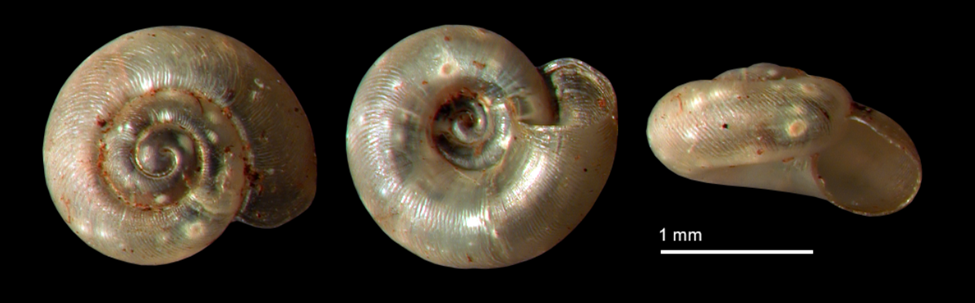
- Patulastra? (Punctum?) pugetensis Dall 1895: 130.
- Radiodiscus hubrichti B.A. Branson 1975: 47, fig. 1a–c.
Identification. Shell subdiscoid, with very low, domed spire. Suture deep. Whorls c. 3½, last slightly descending in adults. Periphery rounded, medial. Width of last whorl c. 2× penultimate whorl. Aperture subrotund, edentulous. Lip thin, simple. Protoconch with close, strong spiral threads. Teleoconch with colabral thin-edged riblets, with spiral threads between, including on base. Umbilicus c. ¼ of shell width. Width to 1.8 mm (wider than high). Shell thin, pale yellowish grey, corneous.
Animal translucent white, with head and tentacles grey and a small black spot over the lung.
Comparison. There is no other snail quite like this species in BC. The pale colour of the shell and intricate microsculpture (not well shown in the photograph) are distinctive among BC microsnails.
Habitat. This species inhabits moist forests where it lives in leaf litter and under woody debris.
Geographic range. In BC, S. pugetensis occurs along the whole coast where it is common. It also is in the southern interior, including the Kootenays, where it is known from a few, scattered records (Ovaska et al. 2020) and the valley of the North Thompson River (Forsyth 2001).
Striatura pugetensis occurs from south-eastern Alaska south to Isla Guadalupe, Baja California, Mexico (Pilsbry 1927; Smith et al. 1990) and east to Glacier National Park, northwestern Montana (Berry 1919). This species was said to also occur in the Hawaiian Islands, on Kauai (Baker 1941), but see Remarks.
Etymology. Striatura: derived from the Latin striatus, furrowed + the –ura suffix to form a noun from an adjective; the gender is feminine. Pugetensis (Latin), of Puget Sound, or the more general region.
Remarks. This species was first described as new by Dall (1895) from material collected at Seattle, Washington by the amateur conchologist P.B. Randolph (see Punctum randolphii). Berry (1919) first recognized this species as a Striatura, and Baker (1928) later placed the species in the subgenus Pseudohyalina. While specimens from northwest Montana were said by Berry (1919: 492) to be “larger and flatter and coarser in appearance, slightly approaching in some respects the giant southern meridionalis Pilsbry and Ferriss [1906]”, Pilsbry (1946) considered these to be typical of S. pugetensis.
By misplacing the heading for the subgenus Striatura s.s., Pilsbry (1946) wrongly indicated that this species belongs in that subgenus, but he corrected this in the following part of his monograph (Pilsbry 1948: 1102).
Specimens from Kauai were identified by Baker (1941) as S. pugetensis, but his figured specimen (pl. 60, figs 1–3) shows a shell with a higher spire and slightly different form than shells from BC (and presumably Puget Sound) material, and one suspects that it is not the same species; the Hawaiian archipelago also has several endemic Striatura species (Baker 1941), so it seems likely that Hawaiian “S. pugetensis”is yet another endemic species, not S. pugetensis.
Radiodiscus hubrichti B.A. Branson, 1975, which was described from the Olympic Peninsula (Branson 1975), was recognized by Solem (1977a, b) as a synonym of S. pugetensis.
If following the classification of Schileyko (2003), who diverged from other authors in treating Pseudohyalina as a full genus, this species would be Pseudohyalina pugetensis (Dall, 1895).
References
Baker HB (1928) Mexican mollusks collected for Dr. Bryant Walker in 1926, I. Occasional Papers of the Museum of Zoology, University of Michigan 193: 64 pp., pl. 6.
Baker HB (1941) Zonitid snails from Pacific Islands, parts 3 and 4. 3. Genera other than Microcystinae. 4. Distribution and indexes. Bernice P Bishop Museum, Bulletin 166: 203–370, pls 43–65. https://babel.hathitrust.org/cgi/pt?id=mdp.39015069709080
Berry SS (1919) Mollusca of Glacier National Park, Montana. Proceedings of The Academy of Natural Sciences of Philadelphia 1919: 195–205, pls 9, 10. https://www.jstor.org/stable/4063842
Branson BA (1975) Radiodiscus hubrichti (Pulmonata: Endodontidae) new species from the Olympic Peninsula, Washington. The Nautilus 89: 47–48. https://www.biodiversitylibrary.org/page/16319395
Dall WH (1895) New species of land shells from Puget Sound. The Nautilus 8: 129–130. https://www.biodiversitylibrary.org/page/27055682
Forsyth RG (2001) A note on the distribution of Striatura pugetensis in British Columbia. The Festivus 33: 57–58. https://www.biodiversitylibrary.org/page/50507922
Ovaska K, Sopuck L, Heron J (2019 [2020]) Surveys for terrestrial gastropods in the Kootenay region of British Columbia, with new records and range extensions. The Canadian Field-Naturalist 133: 221–234. https://doi.org/10.22621/cfn.v133i3.2287
Pilsbry HA (1927) Expedition to Guadalupe Island, Mexico, in 1922. Land and freshwater mollusks. Proceedings of the California Academy of Sciences (4th Series) 16: 159–203, pls 6–12. https://www.biodiversitylibrary.org/page/3174272
Pilsbry HA (1946) Land Mollusca of North America (north of Mexico), vol. II, part 1. The Academy of Natural Sciences of Philadelphia, Monographs 3: frontispiece + i–vi + 1–520.
Pilsbry HA (1948) Land Mollusca of North America (north of Mexico), vol. II, part 2. The Academy of Natural Sciences of Philadelphia, Monographs 3: i–xlvii + 521–1113.
Smith AG, Miller WB, Christensen CC, Roth B (1990) Land Mollusca of Baja California, Mexico. Proceedings of the California Academy of Sciences (4th Series) 47: 95–158. https://www.biodiversitylibrary.org/page/15776117
Solem A (1977a) Radiodiscus hubrichti Branson, 1975, a synonym of Striatura pugetensis (Dall, 1895) (Pulmonata: Zonitidae). The Nautilus 91: 146–148. https://www.biodiversitylibrary.org/page/8273672
Solem A (1977b) Shell microsculpture in Striatura, Punctum, Radiodiscus, and Planogyra (Pulmonata). The Nautilus 91: 149–155. https://www.biodiversitylibrary.org/page/8273675