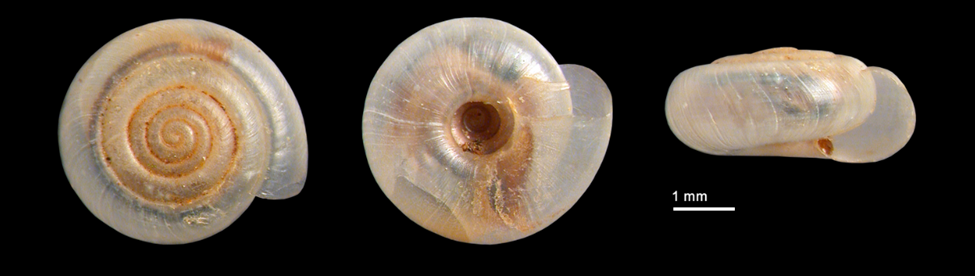
- Zonitoides cookei Pilsbry 1922: 38, fig. 1.
Identification. Shell subdiscoidal. Spire only slightly raised. Whorls c. 5, rather closely coiled and slowly enlarging. Suture moderately indented. Periphery of last whorl rounded. Aperture narrowly lunate, edentulous. Lip thin, simple. Umbilicus small, c. ¼ of shell width. Protoconch smooth. Teleoconch smoothish, under magnification with weak incremental lines and fine, close, spiral lines. Shell with a silky lustre, translucent, milky whitish. Width to 4.4 mm (wider than high).
Animal pale, whitish, not mottled, slightly pale pinkish at spire (seen through shell).
Comparison. Microphysula species are rather distinct from other native land-snail species in BC by the tightly coiled, flattened spire and whitish shell. The introduced Vitrea contracta has a transparent or milky whitish shell but it is smaller, lacks spiral microsculpture (and therefore is glassy, not silky in lustre), and has a smaller umbilicus.
The two species of Microphysula are difficult to distinguish. Pilsbry (1940) suggested that M. cookei is slightly smaller and with less tightly coiled whorls than M. ingersollii. In practice, these species seem not clearly separable on conchological grounds. Identifications of Canadian snails are more apt to be made based on geography: coastal populations have been called M. cookei while those from the Rocky Mountains, M. ingersollii.
Habitat. In BC, mainly wet, montane coniferous forests, and vegetated rockslides at and below tree line (Forsyth 2002); low-elevation, riparian, mature mixed-wood forest on Vancouver Island. The “pine forest” at Cameron Lake, Vancouver Island, mentioned in the original description by Pilsbry (1922) is possibly erroneous, as the tree species possibly were more likely to have been Douglas-fir (Pseudotsuga menziesii (Mirbel) Franco).
Geographic range. In BC, in the coastal ranges on the mainland (Boundary, Coast, Skeena, Bulkley, and Cascade ranges), and on Vancouver Island. Microphysula cookei was described and first reported by Pilsbry (1922) and Pilsbry & Cooke (1922); its type locality is Cameron Lake, Vancouver Island. Forsyth (2001) later reported it from the mountains north of Smithers in north-central BC and at Bear Glacier. Anchorage, Alaska, south to the Cascade and Coast mountains in Washington.
Etymology. Microphysula: derived from micron (Greek), small + physa (Greek), bubble + the Latin diminutive ending –ula. The gender is feminine. This species was named after Dr Charles Montague Cooke Jr (1874–1948), of Honolulu, Hawaii (Wikipedia), who was a friend and malacological collaborator of Henry A. Pilsbry. In July and August 1918, having arrived by steamer, Cooke collected land snails at a couple of places on Vancouver Island, including the type material of this species at Cameron Lake.
References
- Forsyth RG (2001 [2002]) New records of land snails from the mountains of northwestern British Columbia. The Canadian Field-Naturalist 115: 223–228. https://doi.org/10.5962/p.363781
- Pilsbry HA (1922) Description of a new Zonitoides. The Nautilus 36: 38–39. https://www.biodiversitylibrary.org/page/8279836
- Pilsbry HA (1940) Land Mollusca of North America (north of Mexico), Volume I, Part 2. The Academy of Natural Sciences of Philadelphia, Monographs 3: i–viii + 1–994 + i–ix.
- Pilsbry HA, Cooke CM (1922) Land shells of Vancouver Island. The Nautilus 36: 37–38. https://www.biodiversitylibrary.org/page/8279834