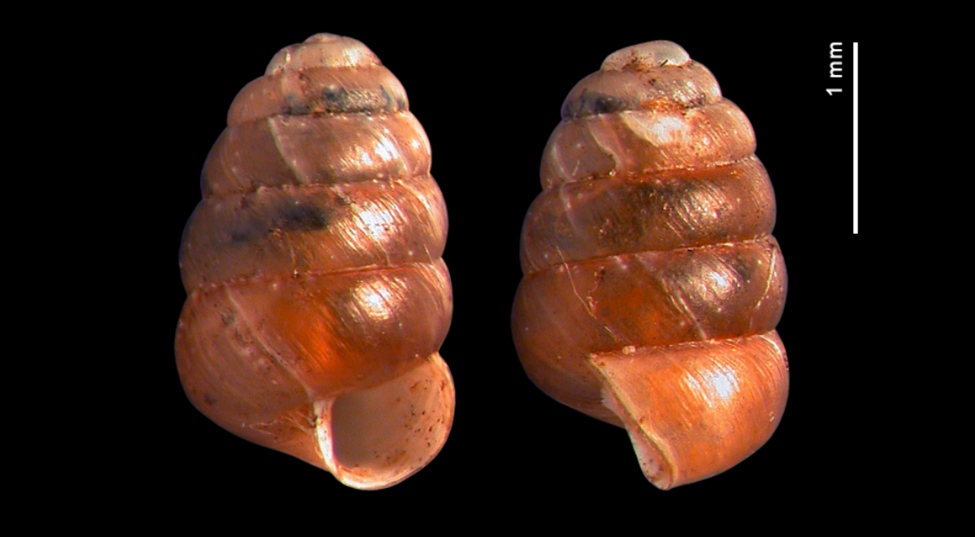
- Pupa simplex Gould 1840: 403, pl. 3 fig. 21.
- Columella edentula of authors (non Pupa edentula Draparnaud 1805 = Columella edentula).
Identification. Shell subcylindrical. Spire elongate, with slightly convex sides tapering to bluntly pointed apex. Whorls c. 5–6, moderately convex; last whorl nearly always larger than penultimate whorl. Sutures rather well indented. Protoconch smooth. Teleoconch with colabral striae. Aperture subovate, wider than high; lacking apertural dentition. Adult lip thin, simple. No umbilicus. Shell subtranslucent, brownish. Shell to 2.8 mm high but usually smaller (higher than wide).
Comparison. The shell is most like C. columella, but generally shorter, with fewer whorls, and with all whorls of the spire evenly enlarging so that the shell is less cylindrical and the last whorl is never smaller in diameter than the preceding whorl. The aperture of C. columella is also decidedly more elongate and thus higher than wide in adults. Juvenile Vertigo species can be difficult to distinguish from juveniles of C. simplex.
Habitat. This species lives in forests and is frequently common on the lower surfaces of Sword Fern (Polystichum munitum (Kaulf.) C.Presl) fronds, on other vegetation, and on stick and twigs, but it also lives in leaf litter.
Geographic range. In BC, C. simplex is common along the coast, but it likely occurs throughout most of BC. However, in the far north of the province and in cordillera areas, it may be replaced with C. columella.
Etymology. Columna (Latin), a pillar + the Latin diminutive suffix –ella; thus, a little pillar or column. Simplex (Latin), simple or plain, originating likely in the contrast to species of Vertigo, which are dentate than thus, not “simple”.
Remarks. Pilsbry (1948) used the name C. edentula for the common North American Columella. Other authors have subsequently regarded C. simplex as the correct name for North American populations (e.g. Hubricht 1985; Nekola and Coles 2010). However, no one has ever explicitly presented evidence for this separation, although variation in shell shape, size, and sculpture is known; even Pilsbry (1948) understood that there are differences in the shells of Columella from Europe and North America. There might be an undescribed west coast Columella species, separate from eastern North American (true)C. simplex. Morphological characters (including shell and visceral spotting; see Pokryszko 1990) suggest more than one species within V. simplex in Canada (pers. obs.). However, C. simplex is provisionally used for now.
References
- Draparnaud J-P-R ([1805]) Histoire naturelle des Mollusques terrestres et fluviatiles de France, ouvrage posthume. Louis Colas, Paris, 164 pp., 13 pls. pp. https://doi.org/10.5962/bhl.title.12856
- Gould AA (1840) Monograph of the species of Pupa found in the United States; with figures. Boston Journal of Natural History 3: 395–404.
- Hubricht L (1985) The distributions of the native land mollusks of the eastern United States. Fieldiana, Zoology (New Series) 24: i–viii, 1–191. https://doi.org/10.5962/bhl.title.3329
- Nekola JC, Coles BF (2010) Pupillid land snails of eastern North America. American Malacological Bulletin 28: 1–29. https://doi.org/10.4003/006.028.0221
- Pilsbry HA (1948) Land Mollusca of North America (north of Mexico), vol. II, part 2. The Academy of Natural Sciences of Philadelphia, Monographs 3: i–xlvii + 521–1113.
- Pokryszko BM (1987) European Columella reconsidered (Gastropoda, Pulmonata, Vertiginidae). Malakologische Abhandlungen Staatliches Museum für Tierkunde Dresden 12: 1–12.