- Helix fidelis Gray 1834: 67.
- Helix nuttalliana I. Lea 1839: 88, pl. 23, fig. 74.
- Helix oregonensis I. Lea 1839: 100, pl. 23, fig. 85.
- Monadenia semialba Henderson 1929: 80.
- ? Aglaia fidelis var. minor W.G. Binney 1885: 121, 493, fig. 91.
- ? Monadenia fidelis celeuthia Berry 1927: 122, fig. 2.
- ? Monadenia fidelis columbiana Pilsbry 1939: 43, fig. 16g, h.
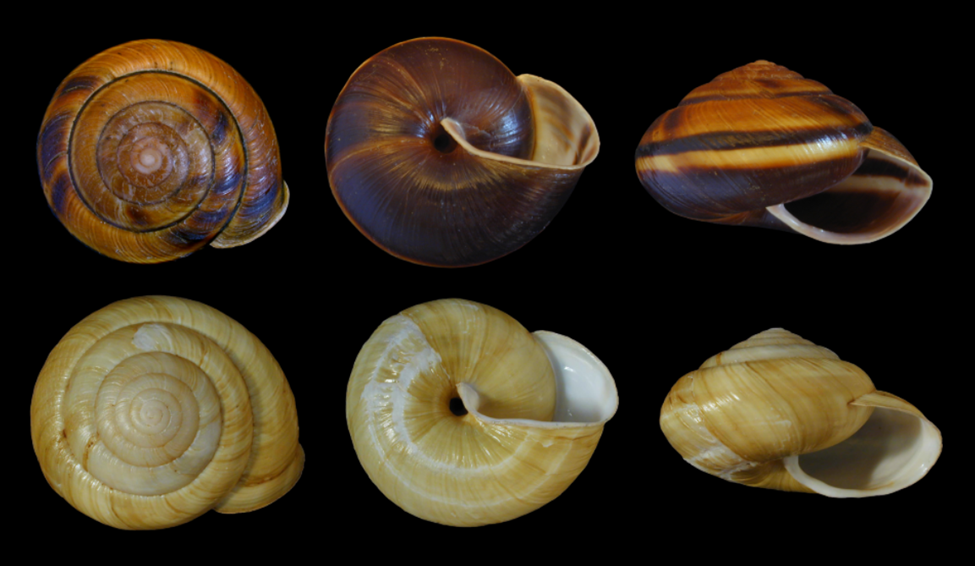
Identification. Shell depressed-heliciform. Spire conical, moderately elevated but rather variable, sides more-or-less straight. Whorls c. 5¼–6¾, convex. Periphery rounded in adults. Suture moderately indented. Last whorl descending before adult aperture. Protoconch initially smooth then microscopically, densely granular. Teleoconch with irregularly sized and spaced, round-topped colabral wrinkles (strongest on the apical surface), and shallow, wavy, microscopic striae (most evident on base). Periostracum frequently showing zigzag pattern of “wrinkles”. Aperture subovate-lunate, edentulous, wider than high. Peristome incomplete. Lip a little thickened, slightly recurved; viewed from side, prosocline and slightly arched. Umbilicus c. 1/8 of shell width. Shell opaque, matte above rather glossy below; usually chestnut brown or rusty yellowish brown, with a narrow, pale-yellow band just below periphery, a slightly wider, dark-brown band above, and a dark-brown base (often slightly greenish towards lip); aperture with the exterior pigmentation clearly showing through a milky whitish enamel; lip pale brown or purplish brown; straw-yellow shells, with faint banding infrequent. Shell to 22.1–36.5 mm (usually averaging 32 mm; wider than high).
Animal rosy-brown, with the spaces between the tubercles greyish; behind the head are some sparse, black reticulations. Mantle with a bold, rust-coloured band; sole of foot pale grey.
Comparison. There is no other land-snail species like this in BC, recognized by its large size, normally striking colour pattern of bands on the shell, and rosy-brown body. Monadenia fidelis is the largest land snail in BC. Cepaea nemoralis is a banded snail, but much smaller.
Habitat. Monadenia fidelis lives in forests generally, but also in open, Garry Oak (Quercus garryana Douglas ex Hook.) meadows, along sandy-grassy seashores with logs, and on rocky islets. It mostly lives under logs and rocks and in leaf litter, but is most often encountered when active, in spring, and then sometimes climbing trunks of trees.
Biology. This species presumably feeds on fungi and plants; animals readily ate a varied diet in captivity, and diet was not correlated to shell colour (Roth 1981). In captivity, individuals of M. fidelis flava reached adult size in 2½–2¾ years and survived up to eight years (Walton 1963, 1970, as M. fidelis beryllica). Monadenia fidelis is a known host of the parasitic ciliate protozoan Tetrahymena limacis (Warren, 1932) (Kozloff 1956).
Geographic range. In BC, coastal, all around the Georgia Depression, north to the Broughton Archipelago (Dall 1905), and inland to around Pemberton and up the Fraser Valley to near Hope. South to Cape Mendocino, California. Reported from Sitka, Alaska (Dall 1905) and the Yukon (La Rocque 1953), but these seem doubtful. In the context of biogeography, the presence of this species in the Yukon is highly unlikely.
Etymology. Monadenia: derived from monos (Greek), one + aden (Greek), gland, which is in reference to the single mucus gland (Pilsbry 1939). The gender is feminine. Fidelis (Latin), dependable or faithful.
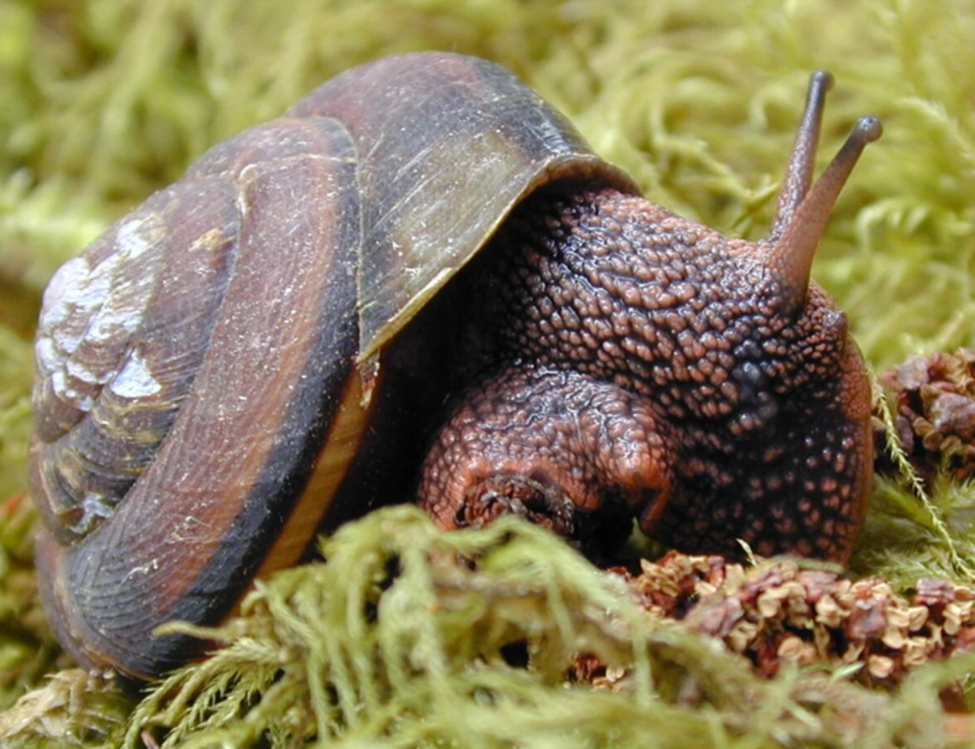
Remarks. Subspecies and forms have been described for this variable and relatively widespread, large, and showy species (Pilsbry 1939), which shows the greatest expression of variation in the southern part of its range (Roth 1981). Branson (1983) investigated shell-colour morphs in dozens of geographically separated and environmentally different sites in Washington and Oregon and found an east–west gradient there. He postulated that moisture regime, vegetation cover, and geographical barriers to dispersal were responsible for these differences. North–south variation in M. fidelis was less apparent.
Monadenia fidelis and related species have had several subspecies named for various shell-colour morphs. Some subspecies continue to be used in the modern literature, while studies of the genetics of other subspecific taxa have shown them to be synonyms of M. fidelis or another species, M. infumata (Gould, 1855) (Roth & Sadeghian 2003). The synonymy here includes the “remainders” which have not been investigated. Probably all Canadian populations belong to the nominotypical subspecies (if these were to be used). Eyerdam (1940) reported M. [fidelis] semialba from Vancouver Island, near Victoria. Monadenia semialba was described from Fidalgo Island, Washington, for a shell polymorphism in which the dark pigment on the base is much reduced and the pale, generally straw yellow subperipheral band is expanded onto the base. Pilsbry (1939) treated this taxon as a subspecies. However, at its type locality, semialba is mixed with normal fidelis (Eyerdam 1937; personal observation) and is treated as colour variant and a synonym.
Roth (1981) hypothesised that the complex pattern of shell colours in M. fidelis allows this large snail to visually blend into its environment by breaking up the large shell into light and dark patches.
References
- Berry SS (1927) A new Oregonian subspecies of Monadenia fidelis. The Nautilus 40: 122–124. https://www.biodiversitylibrary.org/page/8523259
- Binney WG (1885) A manual of American land shells. United States National Museum, Bulletin 28: 1–528. https://doi.org/10.5479/si.03629236.28.1
- Branson RM (1983) Geographic variation of banding and color morphs in Monadenia fidelis (Gray, 1934). The Veliger 25: 349–355, 1 pl. https://www.biodiversitylibrary.org/page/42517293
- Dall WH (1905) Land and fresh water mollusks. Doubleday, Page and Co., New York, New York, USA, 1–171 pp., pls 1, 2. https://doi.org/10.5962/bhl.title.14179
- Eyerdam WJ (1937) Monadenia semialba Henderson. The Nautilus 51: 63–65. https://www.biodiversitylibrary.org/page/9203283
- Eyerdam WJ (1940) Extension of range of Monadenia semialba Henderson. The Nautilus 53: 108. https://www.biodiversitylibrary.org/page/8516402
- Gray JE (1834) [Mr. Gray also exhibited land and fresh-water shells which he regarded as hitherto undescribed]. Proceedings of the Zoological Society of London for 1834 2: 63–68.
- Henderson J (1929) Some new forms of non-marine Mollusca from Oregon and Washington. The Nautilus 42: 80–82. https://www.biodiversitylibrary.org/page/8518859
- Kozloff EN (1956) Tetrahymena limacis from the terrestrial pulmonate gastropods Monadenia fidelis and Prophysaon andersoni. The Journal of Protozoology 3: 204–208. https://doi.org/10.1111/j.1550-7408.1956.tb02457.x
- La Rocque A (1953) Catalogue of the Recent Mollusca of Canada. National Museum of Canada, Bulletin 129: i–x, 1–406.
- Lea I (1839) Description of new freshwater and land shells. Transactions of the American Philosophical Society (New Series) 6: 1–154.
- Pilsbry HA (1939) Land Mollusca of North America (north of Mexico). Volume I, Part 1. The Academy of Natural Sciences of Philadelphia, Monographs 3: i–xvii + 1–573 + i–ix.
- Roth B (1980 [1981]) Shell color and banding variation in two coastal colonies of Monadenia fidelis (Gray) (Gastropoda: Pulmonata). The Wasmann Journal of Biology 38: 39–51. https://www.researchgate.net/publication/260126210
- Roth B, Sadeghian PS (2003) Checklist of the land snails and slugs of California. Santa Barbara Museum of Natural History Contributions in Science 3: 1–81.
- Schileyko AA (2004) Treatise on Recent terrestrial pulmonate molluscs. Part 12: Bradybaenidae, Monadeniidae, Xanthonychidae, Eiphragmophoridae, Helminthoglyptidae, Elonidae, Humboldtianidae, Sphincterochilidae, Cochlicellidae. Ruthenica Supplement 2: 1627–1764.
- Walton ML (1963) Length of life in west American land snails. The Nautilus 76: 127–131. https://www.biodiversitylibrary.org/page/8514575
- Walton ML (1970) Longevity in Ashmunella, Monadenia and Sonorella. The Nautilus 83: 109–112. https://www.biodiversitylibrary.org/page/8515381