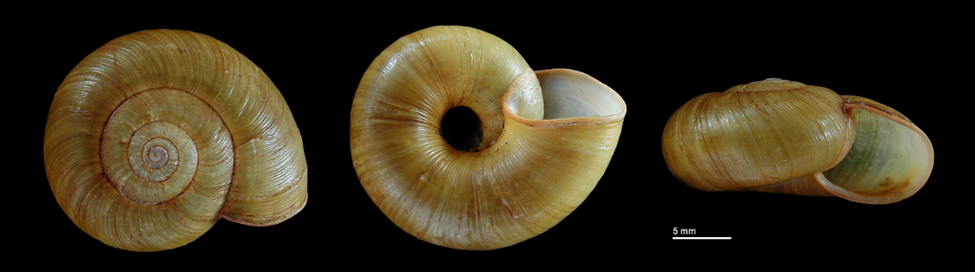
- Helix vancouverensis I. Lea 1838: 87, pl. 23 fig. 72. [Not “1839”.]
- Circinaria vancouverensis var. chocolata Dall 1905: 34.
- ? Helix vellicata Forbes 1850: 55, pl. 9 fig. 1a–c.
Identification. Shell subdiscoidal. Spire very low, scarcely conical. Whorls c. 5. Last whorl much rapidly enlarging (width from above c. 3× width of penultimate whorl). Suture rather shallow. Protoconch smooth. Teleoconch with low, irregular incremental lines, coarsest near suture, and microscopic spiral striae. Aperture subovate, edentulous. Adult lip slightly thickened; arched forward, straightened or somewhat downward drooping. Umbilicus c. ¼ of shell width. Shell matte or somewhat glossy; ochre to olive brown, often with darker streaks; inside aperture whitish.
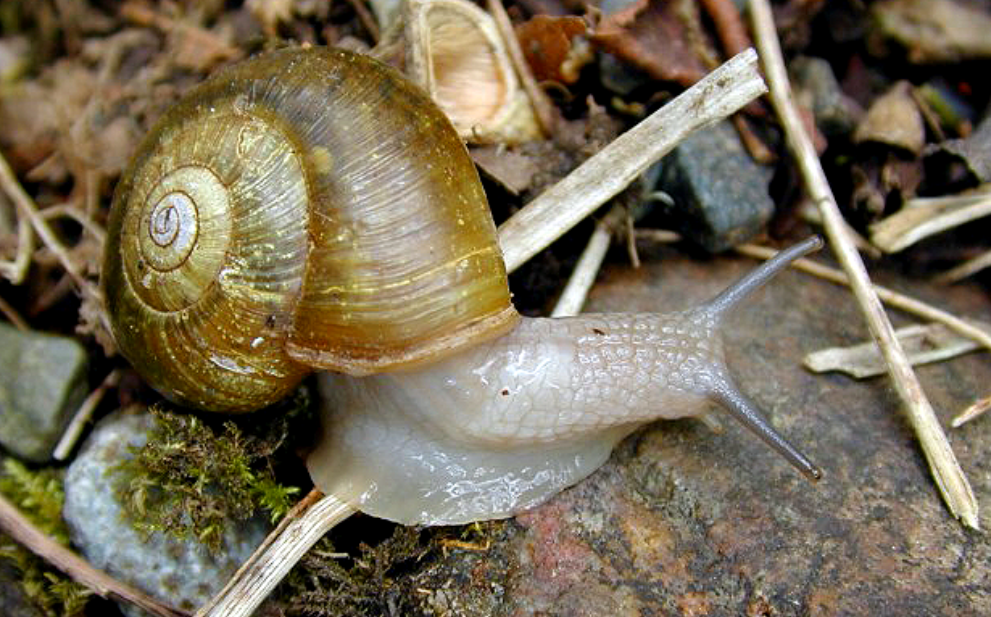
The animal is pearly whitish with a slightly darker head, mauve-grey or blue-grey ocular tentacles, and a tan to brown mantle with large, dark blotches.
Comparison. This is the largest haplotrematid in BC, although some A. hybridum may be equally large. However, their shell sculpture differs. In H. vancouverense the prominent beading (most clearly seen around the umbilicus) of the two Ancotrema species is lacking.
Habitat. This species lives in forests, under rotten logs and around the bases of sword ferns, often deep within leaf litter and loose soil.
Biology. Like other haplotrematids, H. vancouverense is predatory on snails and other invertebrates. For example, Grass (1966) observed this species preying on Vespericola columbianus and millipedes.
Geographic range. British Columbia: along the entire coast, but it is also known (and perhaps rare) from the southern Interior mountains south-east of Trail and south of Salmo (Ovaska et al. 2020).
Aleutian Islands and southeast Alaska (Pilsbry 1946) to Del Norte, Humboldt, and Trinity counties, north-western California (Roth & Sadeghian 2003); east through northern Idaho to north-western Montana (Pilsbry 1946; Brunson & Osher 1957). Although Hanna (1925) believed this species native to Unalaska Island in the Aleutian chain, Eyerdam (1933) thought that that this species was introduced, having observed that he found them always near villages or abandoned settlements and not on other islands of the Aleutian chain.
Etymology. Haplotrema: derived from Greek, haplos, simple + trema, aperture or hole; the gender is neuter. Vancouverense: named for Fort Vancouver (now Vancouver, Washington, USA), where the species was originally found by English botanist and zoologist Thomas Nuttall on the second Nathaniel Wyeth expedition to the Pacific Ocean. The expedition reached Fort Vancouver in late 1834.
Remarks. The publication date of this species is usually given to be 1839 (e.g. Pilsbry 1946), but although read before the society on 21 July 1837, volume 6, part 1 of the Transactions of the American Philosophical Society was published 15 June 1838 (Tryon 1861; Scudder 1885).
Literature and collection records of this species have been found (rather frequently) to be Ancotrema hybridum, but these species are readily distinguished from each other by inspection of the shell microsculpture (Forsyth 2004b).
Helix vellicata Forbes, 1850 has been synonymised with H. vancouverense for many years (since at least Binney and Bland 1869; Pilsbry 1946), but this may be incorrect. Helix vellicata could be a synonym of another species, possibly A. hybridum. Forbes (1850: 55) gave the width of the shell as 22 mm, which is within the range from both H. vancouverense and A. hybridum. However, in Latin he wrote “… sulcato-striatâ, striis minutissimis spiralibus decussatâ …” [furrow-striae, striae minutely spirally decussate]. This suggests that this might be A. hybridum or another haplotrematid having decussate (or beaded) sculpture rather than H. vancouverense, which is much smoother and with sculpture that cannot be considered decussate.
An alternative classification (Schileyko 2000) treats the subgenus Ancomena H.B. Baker, 1931 as a genus: thus, Ancomena vancouverense.
References
- Binney WG, Bland T (1869) Land and Fresh Water Shells of North America. Part I. Pulmonata Geophila. Smithsonian Miscellaneous Collections 194: xii + 316 pp.
- Brunson RB, Osher U (1957) Haplotrema from western Montana. The Nautilus 70: 121–123. https://www.biodiversitylibrary.org/page/8520790
- Dall WH (1905) Land and fresh water mollusks. Doubleday, Page and Co., New York, New York, USA, 1–171.
- Eyerdam WJ (1933) A biological collecting excursion to the Aleutian Islands. The Nautilus 46: 124–128. https://www.biodiversitylibrary.org/page/8519483
- Forbes E (1850) On the species of Mollusca collected during the surveying Voyages of the Herald and Pandora, by Capt. Kellett, R.N.,C.B., and Lieut. Wood, R.N. Proceedings of the Zoological Society of London 1850 18: 53–56, pl. 9. https://www.biodiversitylibrary.org/page/59278541
- Grass A (1966) Some land and freshwater Mollusca from British Columbia, Canada. Part II. Hawaiian Shell News (n.s.) 14 (6): 6–7.
- Hanna GD (1925) Some land shells from the Aleutian Islands, Alaska. The Nautilus 38: 122–127. https://www.biodiversitylibrary.org/page/8525103
- Lea I (1838) Description of new freshwater and land shells. Transactions of the American Philosophical Society (new series) 6: 1–154, pls 1–24. https://doi.org/10.2307/1005319
- Ovaska K, Sopuck L, Heron J (2019 [2020]) Surveys for terrestrial gastropods in the Kootenay region of British Columbia, with new records and range extensions. The Canadian Field-Naturalist 133: 221–234. https://doi.org/10.22621/cfn.v133i3.2287
- Pilsbry HA (1946) Land Mollusca of North America (north of Mexico), 2(1). The Academy of Natural Sciences of Philadelphia, Monographs 3: frontis., i–vi, 1–520.
- Roth B, Sadeghian PS (2003) Checklist of the land snails and slugs of California. Santa Barbara Museum of Natural History Contributions in Science 3: 1–81.
- Scudder NP (1885) The published writings of Isaac Lea, LL.D. Bulletin of the United States National Museum 23: i–lix, 1–278. https://doi.org/10.5479/si.03629236.23.1
- Tryon GW, Jr. (1861) List of American writers on Recent conchology with the titles of their memoirs and dates of publication. Baillière Brothers, New York, New York, USA, 68 pp. https://archive.org/details/listofamericanwr00tryo